

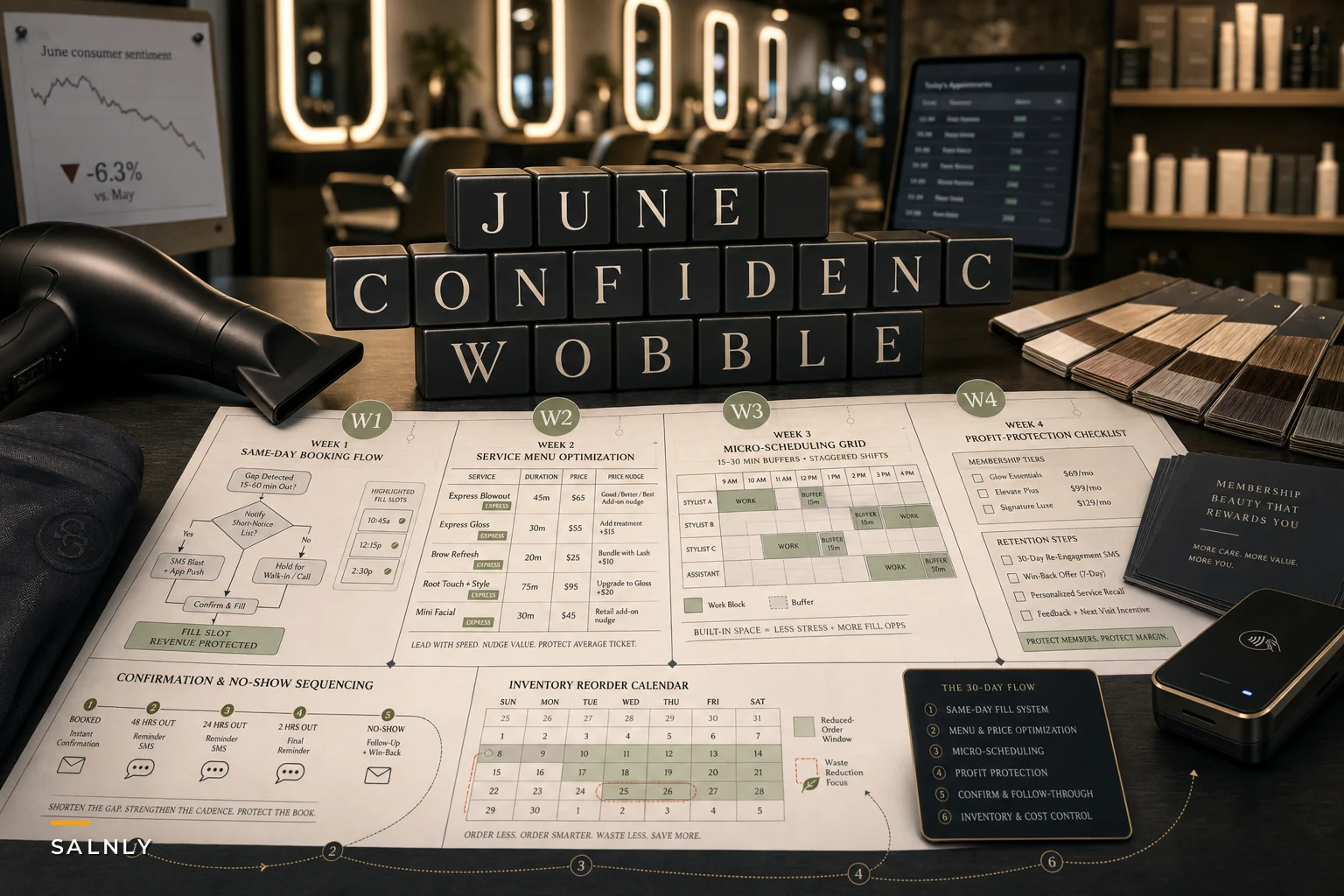

Late June's consumer confidence data landed with a thud. The Conference Board's report showed confidence edging up slightly but with deteriorating labor market perceptions, while Michigan's consumer sentiment survey painted an equally conflicted picture—improved headline sentiment but stubborn cost-of-living anxiety.
For salon owners, this disconnect between "feeling okay" and "spending carefully" creates the worst operating environment: unpredictable demand. Clients still book, but they stretch appointments longer, skip add-ons, and cancel at the slightest inconvenience. Your Tuesday 2pm slot that's always filled? Now it's a maybe.
The damage happens fast. One salon I looked at last month saw their average ticket drop from $85 to $72 in about three weeks—not from price cuts, but from clients quietly downgrading. Full highlights became partial. Weekly blowouts stretched to every other week. The books looked fine on paper, but revenue per chair hour fell around 18%.
This isn't about panicking over economic headlines. Consumer confidence directly impacts salon revenue through small operational shifts that compound quickly. A 10% jump in last-minute cancellations plus a 15% drop in retail attach rates equals a margin squeeze most salons can't absorb for long.
The hidden bleeding starts with booking patterns
Your booking system tells the story first—usually 2-3 weeks before you notice revenue impacts.
It starts with booking hesitation. Instead of scheduling their next appointment at checkout, clients say "let me check my schedule." Your rebook rate drops from 75% to maybe 60%. Then booking windows compress—clients who used to book three weeks out now book five days out. Your schedule becomes a moving target.
Next comes service migration. The $180 balayage becomes a $65 root touch-up. Clients still show up, so utilization looks stable, but revenue per hour tanks. A chair generating $120/hour suddenly produces $80/hour while your overhead stays the same.
The most dangerous phase is selective cancellation. Clients keep necessity appointments—roots, events—but drop discretionary ones: treatments, glosses, styling sessions. Your Wednesday afternoon empties. Junior stylists lose training opportunities. Retail displays gather dust.
| Booking Pattern Shift | Timeline | Revenue Impact | Operational Tell |
|---|---|---|---|
| Rebook hesitation | Week 1-2 | -5% forward bookings | "Let me check" responses up 30% |
| Compressed booking window | Week 2-3 | Unpredictable scheduling | Average lead time drops to <7 days |
| Service downgrading | Week 3-4 | -15% avg ticket | Color services replaced with cuts |
| Selective cancellation | Week 4+ | -20% utilization | Midweek gaps, weekend compression |
Most salons don't track these early warning signs. They notice the empty chairs in week 5 when adjusting is already harder.
Stabilization checklist: your 30-day operational response
Week 1: Booking system adjustments
Stop losing appointments in the chaos.
Salnly helps you book, confirm & manage every appointment—efficiently.
- Centralized appointment management
- Client notifications
- Calendar & staff scheduling
No credit card required
Start with booking friction. Every extra click or confusing policy loses you a wavering client.
Time your own online booking flow—how long from landing page to confirmed appointment? More than 90 seconds and you're losing people. Strip optional fields. Remove the "create account" requirement for first-timers. Name, phone, service. Done.
Adjust your cancellation policy temporarily. Drop the 48-hour requirement to 24 hours for the next 60 days. You'll get more late cancellations, sure, but you'll also capture clients who would have skipped booking entirely due to uncertainty. Track the trade-off—usually worth it during soft demand.
Enable same-day booking for services under $100. Many salons block same-day to "manage workflow," but those restrictions just push uncertain clients elsewhere.
Create booking incentives without slashing prices. "Book within 48 hours, get a free deep conditioning shot" costs maybe $3 in product but keeps your service pricing intact. "Tuesday-Thursday bookings include complimentary bang trim"—zero cost, fills slow days.
When you shorten cancellation windows, track bookings and cancellation volume daily so you can measure the net effect on confirmed appointments.
Week 2: Service menu optimization
Not to cut prices—that's a race to the bottom—but to create accessible entry points without devaluing your work.
Build express versions of popular services. That 90-minute highlight becomes a 45-minute "face-framing highlight" at 60% of the price. Same hourly rate, lower commitment threshold. The two-hour keratin becomes a 30-minute "smooth shot" targeting just the hairline and part.
Bundle to maintain tickets. Instead of clients choosing between a cut or color, create an "$89 refresh package"—trim, gloss, and blowout. Price it below the sum of parts but above any single service. Clients feel they're getting value; you hold a decent ticket.
If you haven't implemented tiered stylist pricing, do it now. Senior stylists maintain premium pricing. Mid-level at roughly 75%. Juniors at 50%. Same services, different price points. Clients self-select based on budget, and your brand stays intact.
Suspend service minimums temporarily. That $200 minimum for Saturday appointments? Pause it. Fill chairs first.
Week 3: Aggressive schedule management
Empty chairs during uncertain demand are pure overhead burn.
-
Implement "power hours"—specific windows where all available stylists take walk-ins only. Tuesday 2-4pm, Thursday 11am-1pm, whatever your slow zones are. Promote these heavily. "Power Hour today: no appointment needed, first-come-first-served." Creates urgency, fills gaps.
-
Double-book strategically—not overlapping appointments, but booking faster stylists with 15-minute buffers instead of 30. Schedule consultations during chemical processing time. Blowouts during color development. Every recovered minute is recovered revenue.
-
Cross-train now. Your colorist needs to handle basic cuts. Your junior needs to manage blowouts solo. Your receptionist should be certified for express services like brow tinting. Flexibility is what prevents dead zones when specific stylists go slow.
-
One "floater" per day. One stylist isn't booked solid but stays available for same-day fills, walk-ins, overflow. Yes, some idle time. But you capture every possible opportunity. Worth tracking—it usually pays off.
Implement "power hours"—promote them heavily and use them to create urgency and fill slow windows.
Week 4: Profit protection tactics
Cut product orders 25% immediately. Use up backbar stock before reordering. Shift to smaller, more frequent orders even if unit costs tick up slightly—cash preservation matters more than bulk discounts right now.
Rethink retail. Stop pushing premium products. Focus on sample sizes, travel versions, necessity items. That $45 hair mask isn't moving. The $12 dry shampoo might. Create "starter kits" at $25-30. Volume over margin for now.
On labor: instead of cutting hours—which triggers staff exits—redistribute them. Senior stylists shift to Tuesday-Saturday. Juniors cover Sunday-Monday at lower wage rates. Everyone keeps hours; you reduce peak-time labor costs without anyone losing a paycheck.
Here's a quick visual of the 30-day response flow.
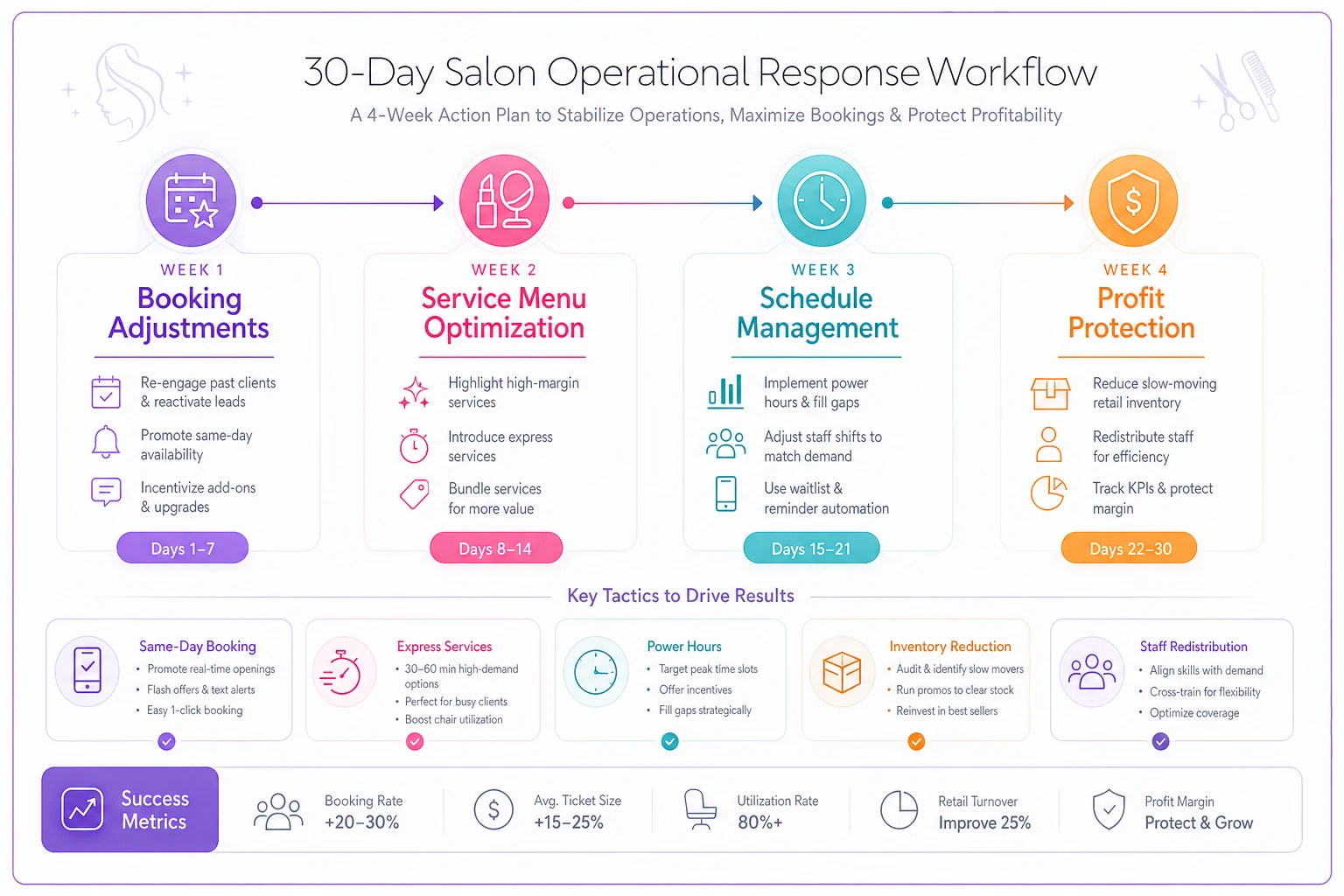
Use this as a checklist reference during the 30 days.
Technical service adjustments that protect both revenue and reputation
Chemical services get stretched strategically. Schedule similar colors back-to-back and mix larger quantities. A single bowl of medium brown can handle three clients with minor adjustments. Saves roughly 20% on color costs without any quality impact.
Processing time becomes productive time. Stop letting clients sit idle during 30-minute color development. Offer express add-ons: brow tinting (5 minutes, around $15), lip wax (3 minutes, $12), hand massage (10 minutes, $20). Minimal training, minimal product, but easily adds $20-30 to each color ticket.
The consultation process shortens but sharpens. No more 15-minute "what are we thinking today?" conversations. A focused 3-minute assessment: desired outcome, budget, maintenance reality. Faster consults mean more service time per hour.
Managing your team through demand uncertainty
Your stylists feel the slowdown before you do. Their books thin, tips shrink, anxiety spikes. Managing this requires transparency—not panic.
Daily huddles, five minutes at opening. Yesterday's numbers, today's goals, one specific focus area. "We're at 73% booked today. Priority is converting walk-ins and retail at checkout." Tactical, not emotional.
Commission structures might need a temporary bump. If stylists typically earn 40%, consider sliding to 45% on off-peak bookings or retail sales. Your margin shrinks, but motivated stylists fill chairs. Better to earn less on something than full margin on nothing.
Create small internal incentives for flexibility. The stylist who grabs a last-minute Saturday shift gets an extra 5% commission that day. Whoever converts the most walk-ins this week picks their schedule first next month. Small rewards drive real behavior.
Don't hide the situation though. Your team already knows when things are slow. Pretending otherwise breeds distrust. Be straight with them: "Bookings are softer, here's the 30-day plan." They'll respect that and work with you.
The technology component: when operational software actually helps
This is where properly configured salon management software earns its keep. Not the flashy features—the basics most salons underutilize.
Your booking platform should automatically flag clients who didn't rebook. Not a monthly report—real-time alerts so your receptionist can call right after checkout. "Hi Sarah, noticed you didn't grab your next appointment. I've got a slot Thursday if you'd like me to hold it?"
Automated confirmations need to work harder too. Instead of "See you Tuesday at 2pm," something like: "Looking forward to your balayage refresh Tuesday! We've got some summer conditioning treatments if you want that extra shine for vacation." Soft upsell built into communication you're already sending.
The waitlist function most salons ignore completely becomes critical here. Not passive lists where clients maybe get a call—active waitlists with automated SMS: "A 3pm slot just opened today for highlights. Reply YES to grab it." First responder wins. You'd be surprised how many gaps this fills.
Inventory tracking tied to appointment types also matters more than usual. System sees six highlighting appointments tomorrow? It flags the mixing supplies needed tonight. Running low on a specific toner? Flagged before you're scrambling mid-service. These aren't revolutionary features—most salon software includes them. But the difference between having them configured versus actually using them might be 15% of your revenue during a slow stretch.
AI-assisted operational platforms can automate a lot of this coordination—sending those waitlist alerts, flagging rebook gaps, prompting retail recommendations at checkout. The value isn't in the technology itself but in the fact that none of it requires your front desk to remember to do it manually when the salon gets busy.
Reading the recovery signals: when to shift back to growth mode
Watch your rebook rate first. When it climbs back above 70% consistently for two weeks, that's your signal to gradually restore normal policies—reinstate 48-hour cancellations, test modest price increases on specific services.
Forward booking patterns tell the fuller story. When average lead time stretches back beyond 10 days and Saturday slots fill by Wednesday, demand is stabilizing. Start pulling back the aggressive promotions and restoring service minimums.
The real indicator? Retail sales. When clients start buying products again—especially premium lines—discretionary spending is back. That's your green light to expand the menu, hire the junior stylist you've been putting off, reorder inventory more aggressively.
Don't flip the switch overnight. Restore one policy per week. Raise one service price at a time. Your clients adjusted to the softer environment; let them adjust back at their own pace.
Beyond the 30-day sprint: building resilience for the next wobble
These confidence dips aren't rare anymore. Between inflation concerns, job market shifts, and general uncertainty, another one is probably coming within 18 months. The salons that survive build operational flexibility into their standard model—not just pull it out during downturns.
Keep multiple service tiers permanently. Those express services and junior stylist options are your shock absorbers. Don't dismantle them when things recover.
Your booking system should always prioritize flexibility over optimization. Perfect 15-minute intervals look clean on a schedule, but buffer time and walk-in slots provide adaptability when patterns shift unexpectedly.
Track the right metrics daily, not monthly. Rebook rate, average ticket, booking lead time, daily retail sales—these tell you what's happening now. By the time monthly reports show a problem, you've already lost significant revenue.
The salons handling this June uncertainty best aren't the ones with the biggest marketing budgets. They spotted the signals early, adjusted quickly, and protected their core economics while demand shifted. Our previous deep-dive on membership economics during spending shifts covers the longer-term membership strategy adjustments that pair with these immediate operational moves.
The broader retail picture and consumer sentiment trends both point to the same thing: spending is holding up for now, but anxiety about costs hasn't gone away. For salons, that's not a crisis—it's a 30-day operational sprint that separates well-run shops from those waiting for things to improve on their own.
Start with the Week 1 booking adjustments tomorrow. Your chairs—and your bank account—will notice the difference.
Ready to simplify your salon operations?
Join 1,000+ salons using Salnly to save time, reduce scheduling chaos, and deliver better client experiences.