

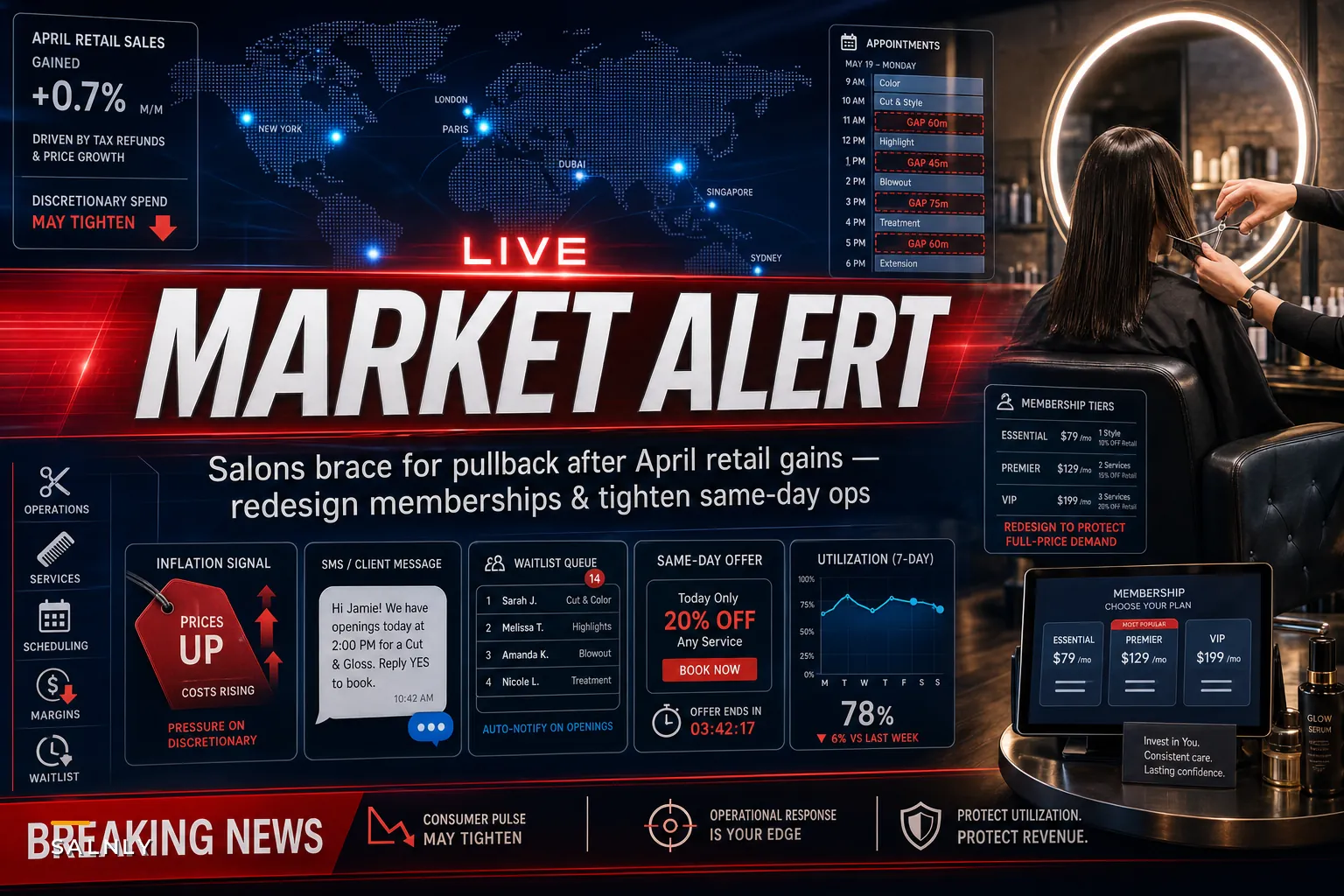

The checkout scanner at my local grocery store just reminded me why salon owners should care about retail sales data from Reuters. April's spending uptick sounds great until you realize it's mostly from tax refunds and higher prices, not genuine consumer confidence. My eggs cost 40% more than last year. My clients' grocery bills look the same.
When essentials eat more budget, beauty services get cut first. Not cancelled entirely—just stretched. The monthly blowout becomes every six weeks. The $180 balayage gets swapped for $85 partial highlights. Regular clients start asking about "just a trim" instead of their usual cut and style combo.
This shift happens quietly. You won't see a mass booking exodus. Instead, Tuesday afternoons get lighter. Same-day availability creeps up. Your front desk fields more price questions. By the time it's obvious, you've already lost two months of revenue momentum.
The membership trap nobody talks about during inflation
Most salon memberships break during economic pressure because they're designed wrong from day one. Owners discount existing services, call it a membership program, then wonder why margins implode when clients change their behavior.
Take your $65 haircut, offer it for $52 monthly, call it a membership. Seems logical. Except when clients tighten spending, they don't cancel memberships—they maximize them. That $52 member who used to add highlights and treatments now comes for their discounted cut only. Your average ticket drops from $145 to $52 while your chair time stays identical.
The math gets uglier with reduced walk-in traffic. Members book their guaranteed monthly slot, but empty chairs between appointments kill your utilization. You're locked into lower-margin services while availability sits unused.
A salon near me had 120 members paying $49 monthly for "unlimited blowouts." Sounded amazing until inflation hit. Members started coming twice weekly instead of weekly. The owner's labor costs exploded while revenue stayed flat. She had to cap visits, members revolted, and she lost 70% of them in two months.
The strongest membership model uses three tiers that protect revenue when spending drops.
-
Maintenance Tier ($35-45/month) - Priority same-day booking - 10% off retail products - Complimentary bang trims - Monthly scalp treatment add-on for $15
-
Enhancement Tier ($75-95/month) - Everything in Maintenance - One monthly express service (glossing, deep conditioning, or styling) - 15% off color services - Rollover credits for unused express services
-
Transformation Tier ($150-200/month) - Everything in Enhancement - Quarterly color consultation with senior colorist - 20% off all services - Two guest passes annually - Exclusive booking window for peak times
Notice what's missing? Straight service discounts. Members pay for access, convenience, and add-on value—not cheaper haircuts.
During inflation, this structure actually helps. Maintenance members feel smart keeping their benefits active for small monthly payments. Enhancement members might pause transformations but keep their tier for the express services. Transformation members stay because the quarterly consultation and booking priority become more valuable when they're spacing out appointments.
Same-day operations: your inflation hedge
When advance bookings soften, same-day availability becomes your revenue lifeline. But most salons handle walk-ins terribly—either overstaffing to accommodate them or turning away revenue when stylists have gaps.
Stop losing appointments in the chaos.
Salnly helps you book, confirm & manage every appointment—efficiently.
- Centralized appointment management
- Client notifications
- Calendar & staff scheduling
No credit card required
The fix requires rethinking how you manage daily capacity. Establish "flex blocks" in your schedule. These aren't held appointments—they're designated windows where stylists can take same-day bookings without disrupting their flow.
Every stylist has two 45-minute flex blocks daily. One mid-morning, one mid-afternoon. During normal booking periods, these fill naturally. When advance bookings drop, they become same-day revenue opportunities.
-
Express refresh cut (dry cut, no wash/style)
30 minutes
-
Gloss & go (toner application while client works)
35 minutes
-
Blowout plus (includes scalp massage or treatment)
40 minutes
-
Root tap touch-up
45 minutes
Price these at 70-80% of full service rates but require 50-60% less chair time. Your hourly revenue stays strong even with lower ticket prices.
Reserve same-day menus for clients who opt into SMS alerts so your messages convert faster and you grow your notification list.
Clients booking same-day aren't price shopping—they need immediate service. Position these as "Express Services" or "Quick Fixes," not "Discounted Appointments."
Building your recession-resistant scheduling framework
Inflation changes how clients book. They plan less, cancel more, and hunt for immediate availability when they finally decide to spend. Your scheduling system needs to accommodate this behavior without crushing utilization.
Start with your confirmation process. When money's tight, clients second-guess appointments. A text 48 hours out saying "See you Thursday at 2pm for your color!" triggers cancellation thoughts. Instead, send value reminders: "Thursday's color appointment includes complimentary conditioning treatment" or "Your stylist has a new technique to share Thursday."
Restructure your cancellation windows. Traditional 24-hour policies create same-day gaps you can't fill. Move to a sliding scale:
-
48+ hours
Full flexibility
-
24-48 hours
Rebook within 14 days or pay 25%
-
Under 24 hours
Pay 50% or apply credit to retail
This keeps clients committed while giving you data on upcoming gaps. When someone cancels 30 hours out, you've got time to fill that slot.
For managing the actual schedule, stop thinking in hour blocks. Break your day into 15-minute increments and track patterns. You'll spot consistent gaps—maybe Tuesday 2-3pm or Thursday 11am-noon. These become your targeted same-day windows.
The early warning system most owners ignore
By the time your P&L shows revenue decline, you're already two months behind. You need leading indicators that catch demand softening before it hits your bottom line.
-
Booking lead time (days between booking and appointment)
-
Service downgrades (clients choosing less expensive options)
-
Retail attachment rate
-
Same-day fill rate
-
Member usage patterns
When booking lead time shrinks from 14 days to 10, clients are hesitating. When color clients switch to cuts only, they're managing budgets. When retail drops but service stays flat, they're prioritizing carefully.
The most telling metric? New client acquisition cost. If you're spending more on marketing for the same number of new clients, the market's tightening. People need more convincing to try new salons during uncertainty.
One owner tracks what she calls "comfort services"—bang trims, beard cleanups, polish changes. When these spike, clients are stretching time between full services. It's her cue to adjust staffing and promote maintenance packages.
Membership psychology during economic pressure
Clients cancel when memberships feel like obligations. They keep them when memberships feel like smart money moves. The difference comes down to flexibility and perceived value.
Structure A: $89 monthly for one haircut plus 20% off color Structure B: $89 monthly for $100 service credit plus priority booking
Same price point. Completely different psychology. Structure A locks clients into specific services. If they don't need a monthly cut, the membership feels wasteful. Structure B gives flexibility—they can bank credits, use them for different services, or treat friends. Even if they skip a month, they're accumulating value.
During inflationary periods, flexibility wins. Clients want to feel in control of their spending, not locked into rigid commitments.
The same-day revenue playbook
Managing same-day revenue requires systematic approach, not reactive scrambling. Here's what actually works when you implement it consistently.
| Time Block | Action | Strategy |
|---|---|---|
| Morning (8-10am) | Review schedule, identify gaps | Text "quick service" list for 45+ minute openings |
| Midday (11am-1pm) | Social media push | Post specific available services, not generic openings |
| Afternoon (2-4pm) | Tomorrow optimization | Dynamic pricing for under-booked slots |
| Evening (5-6pm) | Pattern analysis | Review what filled, adjust tomorrow's strategy |
Morning Protocol: Review the day's schedule. Identify gaps of 45+ minutes. Text your "quick service" list—clients who've opted in for same-day notifications about specific services they want. Message reads: "Hi Sarah, Kate has a 2:15 opening for that glossing treatment you wanted. Reply YES to book."
Midday Push: Post available slots on social with specific services, not just "openings available." Example: "3pm root touch-up spot just opened" performs better than "appointment available today."
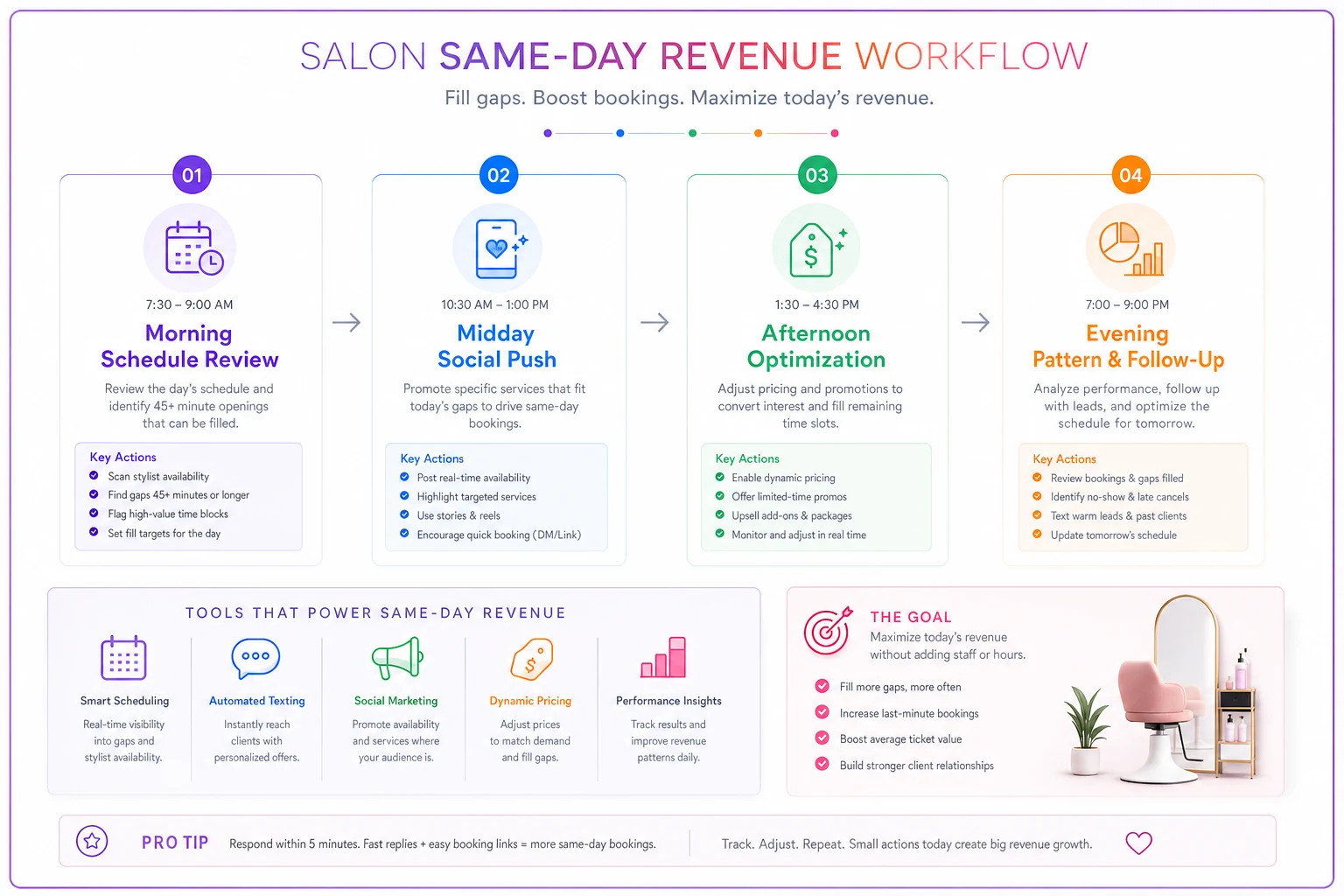
This system works because it's proactive, not reactive. You're not desperately trying to fill chairs—you're strategically matching available time with client needs.
Protecting margins when everyone wants deals
The pressure to discount during inflation feels overwhelming. Clients ask about specials. Competitors advertise sales. Your empty chairs whisper "do something."
Resist blanket discounts. They train clients to wait for sales and destroy your perceived value. Instead, use strategic value adds that protect margins while addressing price sensitivity.
-
Complimentary travel-size product with service
-
Express add-on services at 50% off (not primary services)
-
Points program where spending earns future services
-
Referral credits applied to next visit
-
Retail bundles with service packages
A travel-size shampoo costs you $3 but feels like a $12 value. A 10-minute scalp massage adds minimal time but significant perceived service value.
Track your cost per acquisition carefully. If you normally spend $30 to acquire a client through marketing, you can afford $25 in value adds to retain existing clients. The math almost always favors retention over acquisition.
What AI-powered scheduling actually solves
Managing complex membership tiers, same-day optimization, and dynamic scheduling manually becomes overwhelming. You're juggling member benefits, tracking credits, identifying gaps, sending targeted messages, and analyzing patterns—all while cutting hair.
This operational complexity is exactly what modern scheduling platforms with AI automation solve. They track member usage patterns, automatically identify when clients might churn, suggest optimal same-day services for specific gaps, and even adjust messaging based on booking behavior.
Instead of spending two hours daily managing schedules, you spend 15 minutes reviewing AI-suggested optimizations. The real value isn't the automation itself—it's freeing you to focus on client experience and service quality while the system handles operational complexity.
The platforms track patterns you'd miss manually. Like how Maria always books on Tuesdays but hasn't scheduled in three weeks. Or how your 2pm slot on Thursdays never fills but 2:30pm books consistently. Small operational insights that add up to significant revenue protection.
Smart membership design becomes manageable when the software handles the complexity. You design the value structure, the system manages the execution.
The next 90 days: your action plan
Economic indicators suggest the next quarter will test salon resilience. Consumer confidence wavers. Inflation persists. Discretionary spending contracts. You can't control macro conditions, but you can control your response.
-
Review current membership structure
-
Identify discount-heavy programs
-
Calculate true cost per member
-
Design value-based alternatives
-
Plan transition strategy for existing members
Implement same-day protocols. Create your express service menu. Set up your notification system. Train staff on the new workflow. Start tracking fill rates.
Establish your early warning metrics. Pick five indicators that matter for your specific salon. Track weekly. Set triggers for action—if booking lead time drops 20%, if retail attachment falls 15%, if new client flow slows 25%.
Stress-test your pricing. If you had to operate at 75% capacity, what needs to change? Which services become unprofitable? Where can you add value without adding cost? Better to plan adjustments now than react during crisis.
Making inflation-proof operations sustainable
The salons that thrive during economic uncertainty share common traits. They maintain flexibility without sacrificing structure. They add value without eroding margins. They respond to market signals without panicking.
Most importantly, they recognize that inflation-driven challenges reveal operational weaknesses that always existed. The membership program that breaks during tough times was probably poorly designed from the start. The scheduling system that can't handle same-day optimization was always leaving money behind.
Your clients still want beauty services. They still value self-care. They're just more careful about when, how, and what they purchase. Meet them where they are with smart membership structures and flexible same-day operations. You'll protect revenue today while building loyalty for tomorrow.
Ready to simplify your salon operations?
Join 1,000+ salons using Salnly to save time, reduce scheduling chaos, and deliver better client experiences.