



The federal government just made it easier for banks to charge whatever they want for card processing.
On May 19, the Office of the Comptroller of Currency dropped an interim rule that basically tells states they can't cap credit card fees anymore. The NFIB came out swinging against it, calling it another hit to small businesses already dealing with razor-thin margins.
For salon owners? This lands at the worst possible time. You're already juggling rising product costs, wage pressures, and clients who book less frequently. Now your payment processing — that boring line item you check maybe twice a year — could quietly eat another 0.5% to 1% of every transaction.
Most salon owners have no clue what this actually means for their bottom line. They see "credit card fees go up" and figure they'll absorb it somehow. But when fees inch up even slightly, the math gets ugly fast.
The hidden math that kills salon margins
Take a typical neighborhood salon doing around $42,000 monthly. Nothing fancy — six chairs, mix of walk-ins and regulars, average ticket around $85. Current card processing probably runs somewhere between 2.3% and 2.9% all-in, depending on your processor and card mix.
When fees bump up by just 0.3% — which is exactly what we're looking at if this rule sticks — that's an extra $126 monthly. Sounds manageable until you realize that's $1,512 annually straight out of profit. In a business where net margins hover around 8–12%, you just lost the equivalent of $12,600 in revenue.
The real damage happens at the transaction level though. Every $45 haircut now costs you an extra 14 cents to process. Every $180 color service, an extra 54 cents. Death by a thousand tiny cuts.
What makes this particularly brutal for salons is payment mix. Unlike retail where people might still use cash occasionally, salon clients overwhelmingly pay by card. The days of the cash-heavy salon died around 2018. Now you're looking at 85–90% card transactions, which means these fee increases hit nearly every dollar flowing through your business.
Why salons can't handle this the way other businesses do
Restaurants started adding surcharges. Retail pushed customers toward debit. Gas stations offer cash discounts. But salons operate in this weird middle ground where none of these tactics really work.
Stop losing appointments in the chaos.
Salnly helps you book, confirm & manage every appointment—efficiently.
- Centralized appointment management
- Client notifications
- Calendar & staff scheduling
No credit card required
Your clients expect a premium service experience. They've been coming to the same stylist for years. They tip generously. The moment you add a 3% surcharge to their bill, the relationship shifts. It feels cheap, transactional. One salon I worked with tried surcharging last year — lost 12% of their regular clients within two months.
Cash discounts don't work either because salon visits are rarely impulse purchases. Your client books three weeks out for their color appointment. They're not carrying $200 cash just in case. And honestly, do you really want your stylists handling that much cash throughout the day?
The debit card push fails for a different reason — average tickets. When someone's dropping $150+ on services, they're using their rewards credit card. They want those points. Asking them to use debit feels like you're taking something away from them.
So you're stuck absorbing these costs, which means you need to get creative with operations.
Micro-transactions: the quiet profit destroyer you're not tracking
Most salons have no idea how much they're losing to unnecessary micro-transactions.
Quick example. Sarah books a color service for $165. She shows up, decides to add a gloss treatment for $35. After the service, she grabs a $28 bottle of shampoo. Then remembers she needs to tip, so that's a separate $40 transaction.
Four transactions. Four separate processing fees.
| Scenario | Details |
|---|---|
| Instead of one $268 transaction | costing you roughly $7.76 in fees. |
| You've got four transactions | costing you $9.42 total. |
| Extra cost | That's $1.66 extra just because of transaction splitting. |
Multiply that pattern across 30–40 clients weekly, and you're hemorrhaging $2,500+ annually in completely avoidable fees. The solution isn't complicated, but it requires changing how your front desk operates.
Train your team to bundle everything into single transactions. When someone's checking out, ask about products first. Add the tip before running the card. If they're booking their next appointment, see if they want to prepay.
Some salons have started using appointment deposits to reduce transaction counts even further. Collect $25 when they book, then run the balance as one transaction after service. You cut your transaction fees by 40% without changing anything else.
Bundle products, services, and tips into a single transaction at checkout to avoid extra fees.
Some salons have started using appointment deposits to reduce transaction counts even further. Collect $25 when they book, then run the balance as one transaction after service. You cut your transaction fees by 40% without changing anything else.
The membership model problem everyone misses
Memberships seem like the perfect solution to rising card fees. Predictable monthly revenue, fewer transactions, better cash flow. Except there's a massive operational trap most salons fall into.
When you charge $89 monthly for a membership that includes one service plus 15% off additional services, you're essentially betting that the reduced transaction fees offset the discount you're giving. But the math rarely works out that cleanly.
Your typical member visits 1.7 times per month on average. That means they're using their included service plus booking an additional service every other month. But they're not paying for that second service with their membership. That's a separate transaction, now at a discount.
So instead of reducing transactions, you've just shifted them around while cutting your revenue by 15%. Meanwhile, credit card fees on membership charges are often higher because they're classified as recurring billing, which processors consider higher risk.
The salons that make memberships work despite rising card fees do something different. They front-load value into the membership price itself rather than relying on discounts. Instead of $89 monthly with 15% off, they charge $119 monthly but include two services. No discounts, no confusion, fewer transactions overall.
Building a same-day revenue machine
The fastest way to offset rising credit card fees isn't cutting costs — it's maximizing revenue per transaction. And nothing does that better than same-day add-ons.
But most salons approach this completely wrong. They think same-day revenue means pushy upselling or last-minute service additions that mess up the schedule. That's how you burn out stylists and annoy clients.
Instead, build systematic same-day opportunities into your operations. Start with your appointment confirmation messages. Instead of just confirming time and stylist, include a note about available add-on services that won't extend appointment time. "BTW, we can add a gloss treatment to your color service tomorrow without extending your appointment — just let us know when you arrive."
Track which services naturally pair without adding time. A toner during processing. A deep conditioning treatment while color sets. Brow tinting during a blowout. These aren't upsells — they're convenient additions that clients actually appreciate.
One thing that consistently works: the "while you're here" menu. Physical menu cards at each station listing quick services that can happen during downtime. Stylists don't have to sell anything. Clients see the options and ask about them. Average tickets jump 18–22% without anyone feeling pressured.
Make these additions feel like a service, not a sales tactic. Your processing costs stay flat while revenue per transaction climbs.
The chair rental trap that compounds fee problems
If you're running a chair rental model, rising card fees hit differently. You can't just absorb them into your overall operations because technically, each stylist is their own business. But you also can't pass fees directly to renters without potentially triggering employment classification issues.
The standard approach — having renters get their own merchant accounts — sounds logical but creates chaos. Now you've got six different payment systems, confused clients, and no unified reporting. Plus, individual stylists pay way higher processing rates than you would as a larger account.
The smarter play is centralizing payment processing while building fee coverage into your rental structure. Instead of charging $750 weekly rent plus passing through fees, charge $785 weekly with processing included. Stylists get simplicity, you maintain control, and everyone knows exactly what they're paying.
But when you centralize processing for chair renters, you need bulletproof tracking systems. Every transaction needs to map to the right stylist immediately. Not end-of-day. Not weekly. Immediately.
Without real-time transaction tracking, you're looking at hours of manual reconciliation. Stylists disputing charges. Clients confused about receipts. The administrative burden can eat up any savings from better processing rates.
Inventory financing: the hidden cash flow optimizer
In a high card-fee environment, carrying more inventory actually improves your cash flow if you structure it right.
Most salons order products as needed, maybe monthly. Each order is a separate transaction, often rushed, usually at full wholesale price. But when you shift to quarterly bulk orders with payment terms, everything changes.
Instead of twelve transactions annually at 2.8% each, you're down to four transactions. Better yet, many distributors offer net-30 or net-60 terms on larger orders, meaning you're selling product before you pay for it. The cash flow benefit far outweighs the inventory carrying cost.
Take a typical scenario: ordering $2,000 monthly in retail products. That's 12 transactions, roughly $672 in processing fees annually. Switch to quarterly $6,000 orders on net-30 terms, and you're down to four transactions, $168 in fees. You just saved $504 without changing anything else.
You need storage space and inventory tracking. Nothing fancy — a locked closet and a simple spreadsheet work fine. But you need the discipline to track what's moving and what's not. Dead inventory kills the savings quickly.
Pricing psychology that protects margins without sticker shock
You can't avoid price increases forever. But timing and structure matter more than the actual amount. The salons that successfully raise prices despite fee pressures understand a simple truth: clients hate surprises more than they hate paying more.
The worst thing you can do is suddenly add 3% to everything. Instead, restructure your service menu to build in fee coverage naturally. Combine services that are usually booked together. Create packages that feel like better value even at higher prices. Shift from à la carte to inclusive pricing.
Example: instead of charging $45 for a cut and $35 for style separately (two transactions, two sets of fees), offer a "Complete Cut & Style" for $85. You've raised the total by $5, reduced transaction fees, and clients feel like they're getting a complete service rather than being nickel-and-dimed.
Implementation timing matters too. Don't wait until January when everyone expects price increases. Mid-September works better — clients are settling into fall routines, thinking about holiday looks, more accepting of change. Give 30 days notice, but frame it as a menu update, not a price increase.
Manual reconciliation is killing your profit visibility
Rising card fees hurt more when you can't see them clearly. Most salons check their processing statements maybe quarterly, if that. By the time you notice fees creeping up, you've already lost thousands.
The problem is how processor statements are designed — intentionally confusing, burying the real effective rate under dozens of line items. You see "discount rate 2.3%" but miss the assessment fees, network fees, monthly fees, PCI compliance fees. Your real rate might be 3.1%, but good luck figuring that out from a 15-page statement.
Start tracking your effective rate weekly. Total fees divided by total processed. That's it. No complex analysis needed. Just that one number, tracked consistently.
When salons finally start tracking this, they usually discover they're paying 0.3–0.5% more than they thought. On $50,000 monthly processing, that's $150–250 in surprise fees. Every month. The clarity alone usually motivates them to renegotiate or switch processors.
But manual tracking breaks down fast. You need systematic daily reconciliation or things spiral. Each day's deposits need to match the schedule. Tips need to balance. Product sales need their own category. Without this discipline, you're flying blind while fees quietly eat your margins.
Building your 30-day action plan
You can't fix everything at once, but you can make meaningful progress fast.
-
Week 1
Get clarity on your real processing costs. Pull last month's statement. Calculate total fees divided by total volume. That's your baseline. Now separate transactions by type — services versus retail versus tips. You'll probably find tips have the highest effective rate, which is insane since they're pure pass-through.
-
Week 2
Fix the easy transaction leaks. Train front desk on single-transaction checkout. Bundle services, products, and tips before running cards. Start tracking daily how many transactions per client. Your goal is under 1.3 average. Most salons run around 1.8–2.1, so there's immediate room for improvement.
-
Week 3
Restructure at least three service combinations. Find your most common service pairs and create bundled offerings. Price them $5–8 higher than separate, but still feels like a deal. Market these as "complete experience" packages. Watch transaction counts drop while revenue per transaction climbs.
-
Week 4
Implement same-day revenue capture. Create your "while you're here" menus. Brief stylists on mentioning compatible add-ons during consultations. Don't push sales — just mention options. Track average ticket daily. You should see 10–15% improvement within two weeks.
This 30-day plan focuses on clarity, plugging leaks, and building immediate revenue drivers you can sustain.
Visualize the workflow to keep staff aligned and track progress daily.
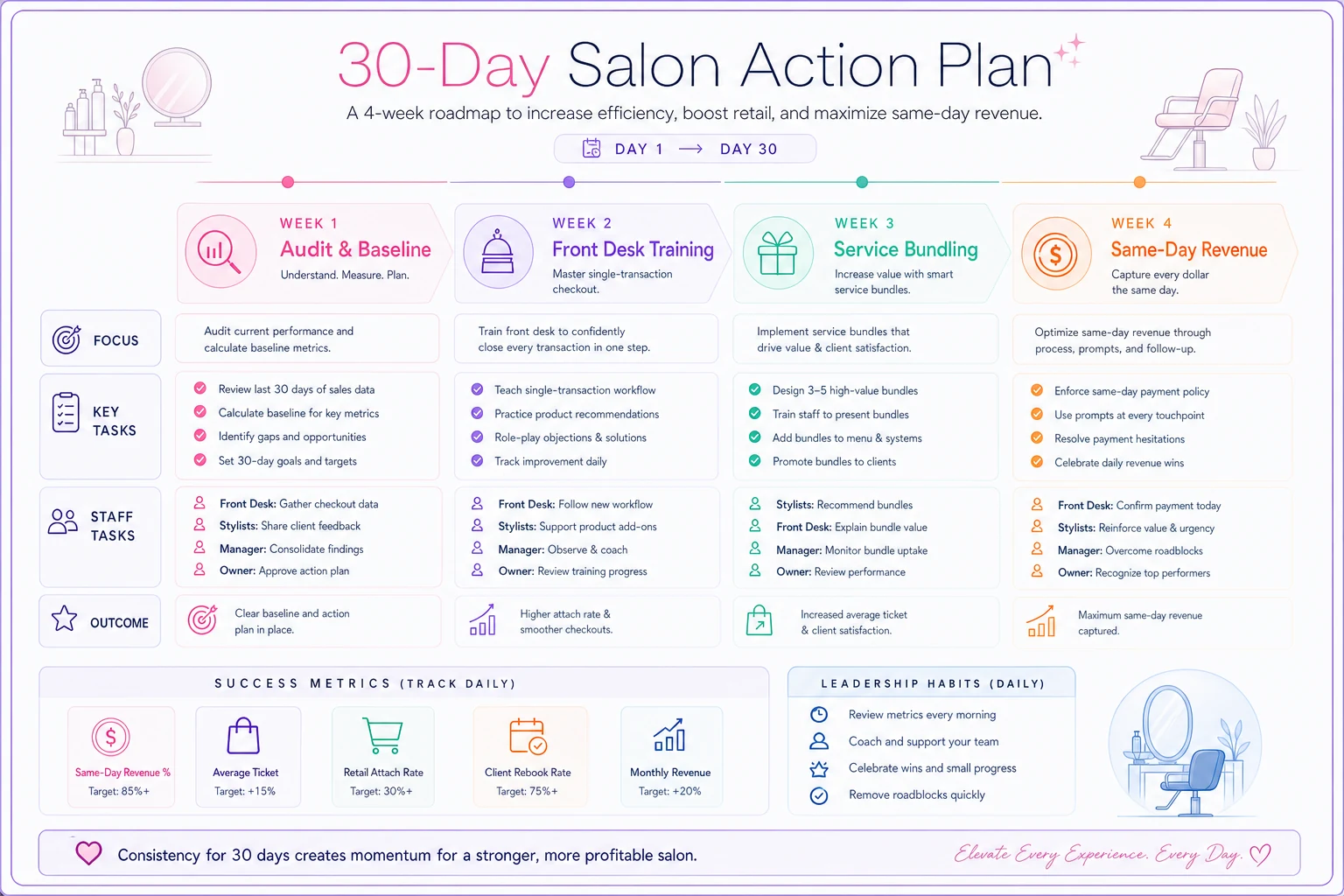
Use this as a staff-facing checklist so everyone knows the week's focus and measured goals.
The 90-day transformation roadmap
Month 2 is about systems and sustainability. Lock in the gains from month one and build toward bigger changes.
Start with payment flow optimization. If you're not already, move to integrated payment processing that talks directly to your scheduling system. The efficiency gain alone usually offsets any switching costs. Every manual entry point is a chance for errors, delays, and additional fees.
Then tackle inventory. Move to quarterly ordering on terms for your top 20 products. These probably represent 80% of your retail sales anyway. Keep monthly ordering for specialty items, but bulk-buy the basics. Track the cash flow improvement — it's usually dramatic.
Finally, address your membership structure if you have one. Same approaches we talked about when consumer spending tightened — simplify the offer, front-load value, reduce transaction complexity. Your goal is members who transact less frequently but spend more per visit.
Month 3 is when you make the structural changes that protect long-term profitability. This might mean switching processors entirely if your current one won't negotiate. It definitely means updating your service menu with the new bundled offerings. And it probably means a systematic price adjustment wrapped into a "menu refresh."
The salons that do this right see something interesting happen — their profit margins actually improve despite rising card fees. Not because they found some magical workaround, but because they finally started treating payment processing as an operational challenge rather than a fixed cost.
Making this sustainable with smart tools
Manually tracking all this stuff is a nightmare. The reconciliation, the transaction analysis, the daily metrics — it's absolutely necessary but painfully time-consuming. You'll do it for maybe three weeks before something else becomes urgent and it all falls apart.
This is where having the right operational backbone makes everything else possible. AI-powered scheduling and payment systems don't just automate the boring stuff — they give you visibility into patterns you'd never spot manually. Which service combinations naturally reduce transaction counts. Which stylists consistently capture same-day revenue. Where inventory is sitting too long.
The real value isn't in the automation itself. It's in freeing you up to focus on the strategic moves that actually protect your margins. While the system handles daily reconciliation, you're negotiating better terms with suppliers. While it tracks transaction patterns, you're redesigning service packages.
The salons crushing it despite rising costs aren't working harder — they're working with better information and cleaner operations.
The bigger picture
The OCC's new rule is just the latest in a long line of cost pressures hitting salon owners. It won't be the last. Next year it'll be something else — insurance, utilities, wages, who knows.
But the ones who survive aren't necessarily the biggest or best-funded. They're the ones who treat every cost pressure as an opportunity to tighten operations.
Rising credit card fees suck. No way around that. But if they force you to finally fix transaction leakage, optimize service bundling, and build better same-day revenue systems, you might actually come out stronger.
The salons still using paper appointment books and manual credit card machines aren't going to make it through this next wave. Neither are the ones who refuse to adapt their service model or pricing structure. But if you're willing to get systematic about operations, to track the boring metrics, to make the unsexy improvements, you'll find profit margins hiding in places you never thought to look.
Start with week one's action plan. Track your real effective rate. Fix the obvious transaction leaks. Then build from there. In 90 days, you'll have a fundamentally different business — one that can absorb the next cost increase without panicking, because your operations are actually optimized rather than just surviving.
The credit card companies might be winning this round, but that doesn't mean your salon has to lose.
Start with week one's action plan. Track your real effective rate. Fix the obvious transaction leaks. Then build from there. In 90 days, you'll have a fundamentally different business — one that can absorb the next cost increase without panicking, because your operations are actually optimized rather than just surviving.
Ready to simplify your salon operations?
Join 1,000+ salons using Salnly to save time, reduce scheduling chaos, and deliver better client experiences.