



Crude rallied hard in the back half of August 2026. Reuters reported oil settling near a four‑week high on the 19th amid uncertainty over exports through the Strait of Hormuz, then jumping more than 2.5% on the 30th after renewed U.S.–Iran military activity. Whether it holds or fades in a few weeks doesn't really matter for your planning. The salon doesn't feel a crude move today — it feels it in October and November, through supplier invoices, freight surcharges, and clients who quietly start stretching six weeks between visits into eight.
That lag is the whole point. Owners who wait until the higher invoices actually land are already a month behind on the moves that matter. So this isn't a piece about geopolitics. It's about the specific, boring line items that shift when oil moves, and the sequence you should run through before the cost actually hits.
Start by mapping where oil actually touches your salon
Most salon P&Ls treat "supplies" as one blob. When input costs move, that blob hides where the damage is. Before you touch a price or a roster, you need to know which costs are oil‑sensitive and which aren't — because they don't move together and they don't move on the same timeline.
Look at the freight/surcharge lines first — they're often the earliest signal.
Here's a rough breakdown of how the exposure sorts out:
| Cost bucket | Oil sensitivity | How fast it hits you |
|---|---|---|
| Petroleum‑based product (foils, plastic caps, some packaging, disposable capes) | High | 3–8 weeks |
| Color, developer, backbar chemicals | Medium | 4–10 weeks, often via surcharge |
| Freight / shipping surcharges from distributors | High | Fast — sometimes next order |
| Retail resale stock | Medium | Passed through gradually |
| Salon utilities (heat, hot water, dryers) | Medium‑low | Next billing cycle or two |
| Staff commute pressure (indirect) | Low but real | Shows up as morale/retention, not a line item |
| Labor | None directly | Only if you react by cutting hours |
The insight buried in that table: the fastest hit isn't product cost, it's freight. Distributors adjust shipping surcharges before manufacturers raise unit prices, because it's easier and less visible. A lot of owners miss it because the surcharge sits at the bottom of the invoice and doesn't change the per‑item price they've memorized. That's the first place to look this week.
The mistake that quietly eats the margin
The reflex when costs rise is to raise service prices across the board. It feels decisive. It's usually the wrong move, or at least a premature one.
Stop losing appointments in the chaos.
Salnly helps you book, confirm & manage every appointment—efficiently.
- Centralized appointment management
- Client notifications
- Calendar & staff scheduling
No credit card required
Blanket price increases hit your most loyal, most price‑aware clients — the ones who book every five weeks and notice a $15 jump instantly — while doing nothing about the actual cost driver, which is often concentrated in product‑heavy services and low‑margin retail. You end up spooking your best clients to recover a cost that lives in maybe a third of your menu.
The more useful pattern: cost moves are almost never evenly distributed across your services, so your response shouldn't be either. A full balayage burns through foils, developer, and chair time. A dry cut burns through almost nothing oil‑sensitive. Raising both by the same percentage is lazy math.
What actually protects margin is going service by service and asking: how much oil‑exposed product does this consume, and what's my current margin on it? Two or three services usually account for most of the exposure. Fix those precisely and leave the rest alone. Your regulars barely notice, and you've defended the line that was actually bleeding.
A 30 / 60 / 90 sequence that respects the lag
Because the cost arrives late, your moves should be staged — quiet and internal first, client‑facing only when you've confirmed the hit is real. Rushing to raise prices on a spike that fades in three weeks just burns goodwill for nothing.
Days 0–30 — measure and pre‑position, don't announce anything:
-
Pull your last three distributor invoices and isolate the freight/surcharge lines. Note the trend.
-
Flag your top 5 product‑heavy services and calculate real margin on each (product cost + chair time, not just product).
-
Place one forward order on your highest‑turn, most oil‑exposed SKUs — foils, developer, disposables — before surcharges climb further. Don't over‑buy slow movers; you're timing, not hoarding.
-
Ask your two main distributors directly whether surcharges are scheduled to change. Reps often know weeks ahead and will tell you if you ask.
Days 30–60 — adjust the few things that need adjusting:
-
Reprice only the 2–3 services where margin actually compressed. Keep the increase modest and specific.
-
Trim SKU depth on slow retail items so you're not carrying capital in stock that's getting more expensive to restock.
-
Tighten your backbar dispensing — over‑pour on color and developer is a real, measurable leak that gets more expensive exactly when inputs rise.
-
Brief the front desk on how to explain any change if a client asks. One honest sentence beats an awkward one.
Days 60–90 — defend bookings, not just margin:
-
Watch rebook intervals. If clients are stretching visits, that's the demand signal — not your booking volume, which lags.
-
Lean on value framing (add‑ons that don't extend chair time, bundled maintenance) instead of discounts that erode the margin you just protected.
-
Re‑baseline. If crude faded, roll back anything temporary so you don't carry a phantom increase into the holidays.
This staged version is the fuller cousin of the short response outlined in our evergreen piece on when oil-driven price shocks hit your salon — worth reading alongside this if you want the compressed checklist.
A simple visual of that 30/60/90 workflow can make implementation easier.
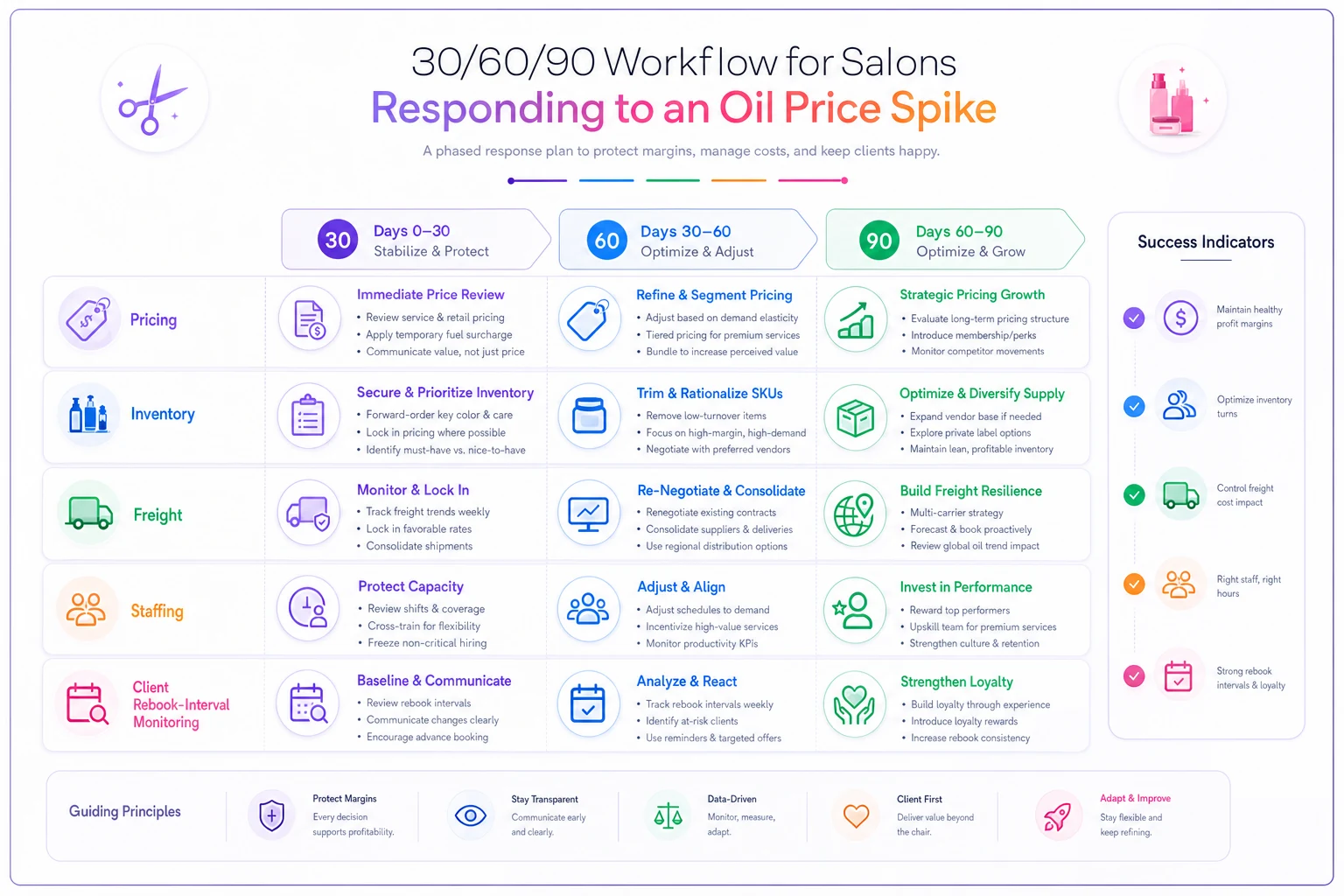
Keep this visualization handy as you run the sequence.
The demand side matters more than the cost side
Owners tend to underweight this part. The supplier invoice is annoying but predictable. The bigger risk from an oil shock is what it does to your clients' heads. Fuel prices are one of the most psychologically visible costs a household faces — people see the number on a sign every day. When it climbs, discretionary spending tightens weeks before anything actually breaks in the broader economy.
For salons, that tightening rarely shows up as cancellations. It shows up as interval creep. The client who came every five weeks quietly moves to seven. Multiply that across a few hundred regulars and you've lost a meaningful chunk of annual visits without a single obvious "lost client" to point at. Your books still look busy. Nothing announces itself.
A quick illustration of how that math bites. Say you've got around 300 active regulars averaging roughly 8–9 visits a year. If interval creep pushes that to 7 visits during a tight stretch, you're looking at a few hundred fewer appointments over the year — and none of it showed up in your cancellation rate. That's why watching rebook intervals in the 60–90 day window matters more than watching your daily booking count. The booking count is a lagging indicator. The interval is the early warning.
Staffing: resist the instinct to cut too fast
When margins feel squeezed, cutting hours looks like the obvious lever. It's usually the most expensive mistake available. Rebuilding a trained stylist costs far more than carrying them through a soft eight‑week stretch, and cutting hours during a period when commute costs are already stressing your team is how you turn a temporary cost bump into a permanent retention problem.
The smarter move is roster precision, not roster reduction. Look at your genuinely dead hours — the ones your own booking data already shows — and tighten scheduling around real demand instead of making blanket cuts.
-
Are you cutting hours based on this week's fear or on 8+ weeks of actual booking data?
-
Which specific low‑demand blocks can be consolidated without touching anyone's core income?
-
Are your product‑heavy, high‑margin services staffed with the people who work efficiently through product?
-
Have you told the team what's happening? Silence during a cost squeeze breeds more anxiety than the squeeze itself.
If Tuesday mornings run at 40% capacity most weeks, that's a scheduling conversation, not a headcount one. You protect the team and stop paying for empty chairs at the same time.
A real scenario
A mid‑size color‑focused salon — two owners, six chairs, somewhere around 330–360 appointments a month — noticed distributor freight surcharges creeping up after a crude run. Their instinct was a flat 8% bump across the whole menu.
Instead they mapped exposure first. It turned out roughly 70% of the cost pressure sat in three services: full balayage, full color correction, and a keratin treatment that leaned heavily on disposables. They repriced only those three by a modest amount, forward‑ordered foils and developer before the next surcharge tier, and tightened color dispensing at the backbar where over‑pour had been quietly running high.
Net result over the following quarter: they recovered most of the margin hit without touching the price on any of their high‑frequency services — the cuts, the roots, the blowouts their regulars book constantly. No visible client pushback, no meaningful interval creep. The flat 8% would've protected the same margin on paper while rattling the exact clients they most needed to keep booking.
Where systems quietly do the heavy lifting
None of this requires fancy tooling — but it does require data you can actually see. The owners who handle cost shocks well aren't smarter; they just have the numbers in front of them. Real per‑service margin, freight trends across recent invoices, rebook intervals by client cohort, capacity by hour. When that lives in someone's head or across three spreadsheets, you react late and broadly. When it's visible in your operational platform, you can react early and precisely.
That's the practical case for having your booking, inventory, and client history connected rather than scattered. Not because software fixes an oil spike — it obviously can't — but because the difference between a surgical response and a panicked blanket price increase almost always comes down to whether you could see where the cost was hitting before it landed.
The takeaway
An oil spike is a stress test for how well you actually know your own margins. The owners who come through it clean don't move faster on price — they move earlier on measurement, and they move surgically. Map your real exposure, protect the two or three services actually bleeding, watch rebook intervals more closely than booking volume, and keep your team steady through the soft weeks. Do that, and a crude rally that rattles the headlines becomes a quarter you manage quietly instead of one that manages you.
Ready to simplify your salon operations?
Join 1,000+ salons using Salnly to save time, reduce scheduling chaos, and deliver better client experiences.