



The Federal Reserve held rates steady again at their July 29 meeting, keeping the federal funds rate parked at 3.50–3.75%. For salon owners, this isn't abstract economic news — it's a squeeze on both ends of the business at once. Clients are dealing with sustained higher costs, and your own financing expenses aren't going anywhere.
Salons that survive rate-hold cycles don't wait for conditions to shift. They adjust operations fast, protect cashflow aggressively, and make uncomfortable decisions about services and staffing before they're forced to.
The real damage happens in weeks 3–8
Most salons feel the initial shock right away — bookings might drop 8–12% in the first couple of weeks after sustained rate news hits. That's manageable. The real problem shows up later when three things stack on top of each other: regulars start spacing appointments further apart, new client acquisition gets more expensive as everyone competes for fewer dollars, and your best stylists start getting nervous about their commission checks.
By week eight, salons without a response plan are making panic decisions — slashing prices, cutting hours across the board, or just doing nothing while cashflow quietly evaporates.
The response needs to happen now, not when you're already underwater.
Weeks 1–2: Cashflow triage and booking protection
First priority isn't growth — it's stopping the bleeding. Pull your appointment data from the last 90 days and identify your cashflow anchors: the 20–30% of clients who book monthly or more. Not necessarily your highest spenders per visit, but your consistent revenue base.
Stop losing appointments in the chaos.
Salnly helps you book, confirm & manage every appointment—efficiently.
- Centralized appointment management
- Client notifications
- Calendar & staff scheduling
No credit card required
Build a retention fence around these clients immediately. Not discounts — that's a race to the bottom. Lock in their next three appointments at today's prices with a small deposit ($25–40). Frame it as inflation protection for loyal clients. One salon I worked with converted close to half their regular base to this model in ten days, guaranteeing roughly $31k in forward revenue.
Prioritize clients who book monthly or more when offering deposit-backed appointment locks to maximize forward revenue visibility.
At the same time, get serious about daily cashflow tracking. Not monthly P&L reviews — actual daily cash positions. How much came in yesterday, how much is expected today, what's committed for tomorrow. Most salon operational software can surface this automatically. If yours can't, build a simple spreadsheet covering: cash collected yesterday, expected cash today based on confirmed appointments, committed expenses tomorrow, and a rolling 7-day position.
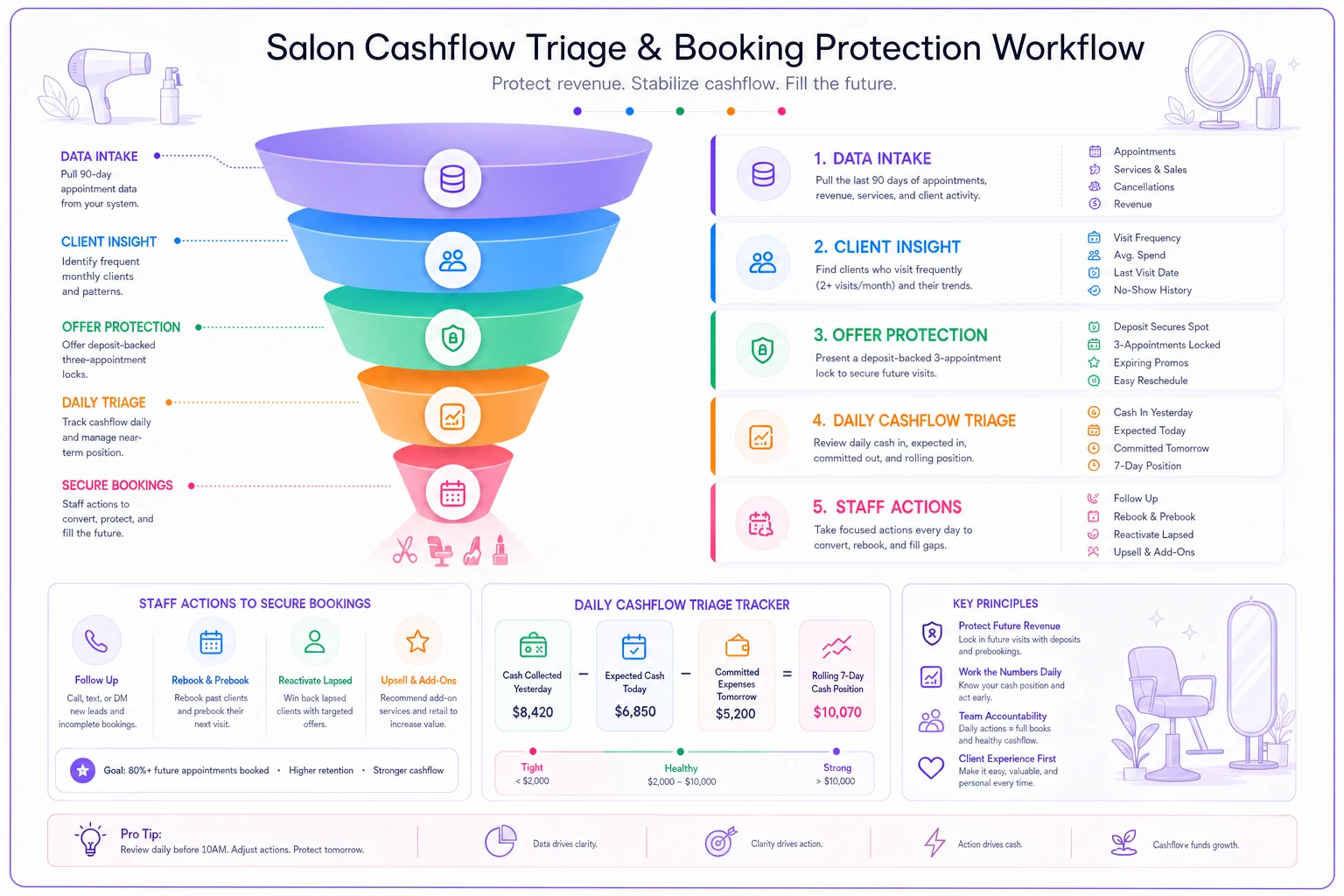
Salons that fail during rate squeezes don't run out of profit — they run out of cash. There's a meaningful difference.
Weeks 3–4: Service menu surgery
Roughly 30% of your service menu is probably destroying margins right now. The deep conditioning add-on that takes 20 minutes for $15. The beard trim thrown in free with men's cuts. These made sense when clients were spending freely. Now they're bleeding margin.
Run this calculation on every service:
(Service price − product cost − (stylist hourly rate × service time)) ÷ service price = true margin %
Anything under 35% needs attention.
-
Bundle them with high-margin services at a package price that improves the combined margin
-
Raise the price 15–20% and accept some volume loss
-
Cut them entirely and redirect chair time to profitable work
A downtown salon I analyzed had 12 services sitting under 30% margin, consuming about 18% of chair time. By bundling six, repricing four, and cutting two, they recovered roughly $4,100 monthly in margin without losing a single regular client.
Don't make a big announcement. Train reception to guide clients naturally: "We've restructured that into our signature treatment, which includes..." works far better than "We don't offer that anymore."
Weeks 5–6: Staffing realignment without losing your best people
When bookings drop, stylists know immediately. The good ones start looking at their options. The traditional response — cutting hours across the board — punishes your best performers while barely impacting your weakest. That's exactly the wrong move.
Instead, build performance-based scheduling tiers.
Track each stylist's last 60 days across four metrics: revenue per hour, rebook rate, retail attachment rate, and client retention. Your top 30% get schedule priority and guaranteed minimums. The middle 40% get flexible scheduling based on demand. The bottom 30% need a performance improvement conversation or a transition plan.
One multi-location group that did this during a previous rate spike reduced total payroll by about 11% while actually increasing hours for their top performers. The best stylists felt more secure. Several marginal stylists self-selected out, which saved difficult conversations.
Build the actual schedule around real demand patterns. If Mondays are consistently slow, don't staff them as if they're not. Three stylists at 85% utilization beats five at 50% every time.
The membership trap
Every salon software vendor is pushing memberships as the cashflow solution. They're half right. But poorly structured memberships during a downturn quietly become margin destroyers.
The problem: clients who normally book every 6–8 weeks join memberships and suddenly start coming every 4 weeks because they've "already paid." Chair utilization looks healthy on paper while you're actually servicing clients at 40–60% of normal revenue.
If you have memberships, audit them now. Calculate actual service delivery cost versus membership revenue — including increased frequency, not just the discount. A lot of salons find their memberships running at negative margins when fully utilized.
-
Set minimum intervals between services (no more frequent than every 5 weeks)
-
Build in retail credits instead of service discounts
-
Create capacity-managed memberships that are only valid during slower periods
Track these against your break-even calculations. The moment membership clients are consuming more margin than they contribute, adjust terms for new signups.
Weeks 7–8: Supplier renegotiation and inventory cleanup
Suppliers are feeling pressure too — order volumes are dropping across the industry. This creates a negotiation window that won't stay open long.
Contact your top three suppliers with a simple message: you're evaluating your product lineup for the next 6–12 months and considering consolidation. Don't threaten to walk. Just mention you're "optimizing supplier relationships" given current conditions.
A significant portion will offer immediate concessions — volume discounts at lower thresholds, extended payment terms, reduced free shipping minimums. One salon negotiated net-60 terms (up from net-30) with their primary color line, effectively creating an $8,000 interest-free credit facility without any formal financing.
Then run an inventory turnover analysis. Calculate days-on-hand for each SKU. Anything over 90 days is frozen cash. Build a liquidation plan: bundle slow movers with popular services, offer them as upgrade incentives, or accept the write-down and recover the cash. Every dollar sitting in expired deep conditioner isn't available for payroll.
Add-on revenue hiding in plain sight
When core service demand softens, add-ons become critical. But the standard "would you like a deep conditioning treatment?" approach converts at maybe 5–10% in tough times.
Salons holding revenue are using structured service flows instead. Not pushy sales — specific consultation moments that make add-ons feel like natural next steps.
Start in the pre-service consultation. Rather than asking about add-ons, have stylists name what they're observing: "I'm noticing some dryness here" or "This area could really benefit from a bonding treatment." Plant the idea before the service starts.
During the service, use natural pause points — while color processes, during a rinse, while heat styling — to introduce relevant add-ons based on what the stylist is actually seeing. Not a generic menu recitation.
Bundle at incremental pricing. A $45 glossing treatment alone feels steep. A $22 gloss added to color feels like smart maintenance. Same margin, completely different psychological frame.
Track add-on attachment rates by stylist, service type, and time of day. Patterns will emerge — certain stylists naturally integrate add-ons, certain services create obvious openings. Double down on what's already working.
The waiting list system that actually fills chairs
Empty chairs during a downturn are especially painful when rent and utilities don't stop. Most salons have waiting list systems but few use them well when things slow down.
Build a same-day fill protocol with three tiers:
-
Clients with appointments in the next 48 hours who might move up
-
Regular clients without upcoming appointments
-
Lapsed clients you're trying to reactivate
Message timing and framing matter a lot. Skip the "we have openings!" broadcast. Position it as exclusive access: "Sarah just had a cancellation for her 2pm — would you like me to hold it for the next 10 minutes?"
The 10-minute hold creates real urgency and forces a quick decision while still feeling exclusive rather than desperate. Conversion runs around 35% when framed this way. One salon automated this through their operational platform and filled an average of 4–6 same-day slots daily — roughly $320–480 in recovered daily revenue. During a demand squeeze, that's the difference between making payroll comfortably or scrambling to cover it.
Retail as a margin protector, not an afterthought
Retail typically generates 8–15% of salon revenue. Salons that hold up during rate squeezes push this toward 20–25% — not through aggressive selling, but by integrating it into service delivery itself.
Every service should have a prescribed retail "prescription" — the specific products needed to maintain the result at home. Not a recommendation. Positioned as part of the service.
Put retail at every touchpoint: reception desk, each styling station (travel sizes), washrooms with QR codes for ordering, checkout (impulse sizes). Make purchasing frictionless.
One underused move: "retail therapy" appointments. These are 15-minute consultations specifically for product and color matching, priced around $25 but fully redeemable against a purchase. Clients get real personalized attention. You get guaranteed retail activity and an entry point for clients who haven't been in recently.
Track retail dollars per service ticket, not just total retail. That metric shows which services naturally drive product sales and which stylists are successfully working retail into their flow.
Your 30-day defense plan
All of this only works if there's a structure behind it. Build a simple one-page dashboard tracking five metrics daily:
-
Cash collected
-
Appointments booked for tomorrow
-
Retail sales
-
Add-on attachment rate
-
No-show and cancellation rate
Review these every morning. When any number drops below your threshold, trigger a specific response. Low tomorrow bookings? Run the same-day fill protocol. Low retail? Run the prescription consultation process. Low add-ons? Review the pre-service consultation flow.
| Metric |
|---|
| Cash collected |
| Appointments booked for tomorrow |
| Retail sales |
| Add-on attachment rate |
| No-show and cancellation rate |
The salons that fail during rate squeezes don't lack good ideas — they lack execution speed.
Your team also needs clarity. Not fear-mongering, but honest context: "The market is tough right now. Here's our plan, and here's how you can help protect your own income through it." That framing lands differently than vague reassurance.
The operational piece you can't ignore
Manual tracking and executing these protocols burns time exactly when you have the least of it. Modern salon operational platforms can automate the critical workflows — same-day fill notifications, daily metric dashboards, membership utilization tracking, inventory turnover alerts. The time you recover from spreadsheet management goes back into keeping your team focused and clients feeling taken care of.
Salons with systems in place execute their response consistently. Those running on memory and manual processes fall behind quickly when conditions get choppy.
Looking forward while protecting today
This playbook isn't about hunkering down. The cashflow discipline, the margin focus, the systematic add-on and retail protocols — these make the business stronger regardless of what rates do. The salons that come out of these periods ahead are usually the ones that used the pressure to cut operational waste they'd been tolerating anyway. They find their real break-even points, identify their most profitable services and clients, and build repeatable systems they'd never bothered building during easier times.
Start with week one's cashflow triage. You can't execute the rest of the plan if you run out of cash before you get there.
The Fed's decision to hold signals this environment continues for at least another quarter, possibly longer according to CNBC's coverage of the meeting. That's enough runway for prepared salons to build a real competitive advantage while others scramble to react.
Your clients still need services. They're just being more selective about where they spend. Run tighter operations than your competitors while keeping the experience that made clients choose you in the first place — that combination is harder to pull off than it sounds, but it's what separates the salons still standing when conditions eventually improve.
Ready to simplify your salon operations?
Join 1,000+ salons using Salnly to save time, reduce scheduling chaos, and deliver better client experiences.