



Last week changed everything for how you classify your salon managers. The Department of Labor's technical amendment just restored FLSA salary thresholds, meaning that salaried assistant manager making $48k? They're probably overtime-eligible now unless you bump their pay significantly or restructure their role.
The timing couldn't be worse. Salon margins are already tight, and suddenly you're looking at either raising salaries by thousands or dealing with overtime costs that could spiral out of control. Most salons operate on 8-12% profit margins — one mismanaged schedule with your newly non-exempt manager working 45 hours could eat an entire week's profit.
Owners are scrambling to make snap decisions without understanding the operational ripple effects. Bumping someone to the new salary threshold might save you from overtime, but now you've created pay compression issues with your senior stylists. Cutting hours to avoid overtime? You just lost coverage during peak Saturday rushes.
The real classification mess hiding in your payroll
Most salon owners don't realize they've been misclassifying employees for years. That "lead stylist" you've been paying salary? Unless they're actually managing other employees at least 50% of their time, they were never exempt in the first place. The DOL change just forced everyone to look at something that was already broken.
I pulled payroll data from three salons last week. One had their "salon coordinator" classified as exempt administrative — except she spent 80% of her time checking in clients and answering phones. That's not administrative work under FLSA rules. She should have been getting overtime for the past two years.
Another salon had their assistant manager properly classified but barely above the old threshold at $46,000. To keep them exempt under the new rules, they'd need to jump to roughly $58,000. The owner's first instinct was to just pay it, until we mapped out what that meant for their entire pay structure.
When you bump one person's salary by 25%, everyone notices. Your senior stylists making $45,000 plus commission suddenly wonder why the assistant manager jumped ahead. Your reception lead starts asking questions. Within three months, you're dealing with turnover or forced to adjust everyone's compensation upward.
The classification audit itself takes about two hours. List every salaried position, then track what they actually do for a week. Not what's in their job description — what they physically spend their time doing. If your "manager" is cutting hair 30 hours a week and doing admin work for 10, they're not exempt regardless of salary.
Why traditional scheduling breaks under the new rules
Standard salon scheduling assumes flexibility. Your assistant manager covers when someone calls out, stays late for walk-ins, comes in early for inventory. That informal coverage system falls apart the second they're non-exempt.
Stop losing appointments in the chaos.
Salnly helps you book, confirm & manage every appointment—efficiently.
- Centralized appointment management
- Client notifications
- Calendar & staff scheduling
No credit card required
Think about your typical Saturday. Assistant manager scheduled 9-5, but a stylist calls out at 8am. Previously, they'd come in early, stay until close, whatever it took. Now? Every hour past 40 costs you time-and-a-half. That emergency coverage just became 50% more expensive.
The math gets ugly fast. Assistant manager at $50,000 annually makes roughly $24 per hour. Their overtime rate? $36. Work just five overtime hours weekly and you're looking at an extra $4,680 annually. Work ten hours? Nearly $10,000. That's assuming you even track it properly — many salons don't have systems to monitor when salaried employees hit 40 hours.
Most salons try to solve this with rigid scheduling rules. "Nobody works over 40 hours, period." Except that doesn't work when you need coverage. You end up with gaps during peak times, or owners working 70-hour weeks to avoid paying overtime.
The better approach requires completely rethinking coverage patterns. Instead of relying on one flexible assistant manager, you need overlapping shifts with clear handoff points. But that means scheduling more bodies during transition periods, which increases labor costs even without overtime.
Building overtime-proof shift templates
Forget everything you know about "normal" salon scheduling. The old model where managers float between tasks all day doesn't work when every minute counts toward overtime.
Start with fixed 38-hour schedules for any non-exempt managers. Why 38? Because it gives you a two-hour buffer for the inevitable situations where they need to stay late or come in for an emergency. Hit exactly 40 every week and you're one delayed client away from overtime.
Assistant Manager Schedule (38 hours)
-
Monday
10am-6pm (7.5 hours, 30-min break)
-
Tuesday
9am-5pm (7.5 hours, 30-min break)
-
Wednesday
OFF
-
Thursday
11am-7pm (7.5 hours, 30-min break)
-
Friday
9am-5pm (7.5 hours, 30-min break)
-
Saturday
9am-5pm (7.5 hours, 30-min break)
Notice the staggered start times? That creates natural coverage overlap with your stylists' schedules. The Wednesday off splits their week, reducing the chance of accumulated overtime from consecutive long days.
Templates only work if you enforce them religiously. One salon I worked with had beautiful schedules on paper, then ignored them completely in practice. Their assistant manager was "just helping out" an extra 8-12 hours weekly. Three months later, they'd blown through their entire profit margin.
The enforcement mechanism matters more than the schedule itself. Clock-in systems that alert you at 37 hours. Automatic notifications when someone approaches overtime. Clear protocols for who approves any work beyond scheduled hours. Without these controls, your templates are just suggestions.
This workflow diagram shows the template -> alert -> approval process you should implement.
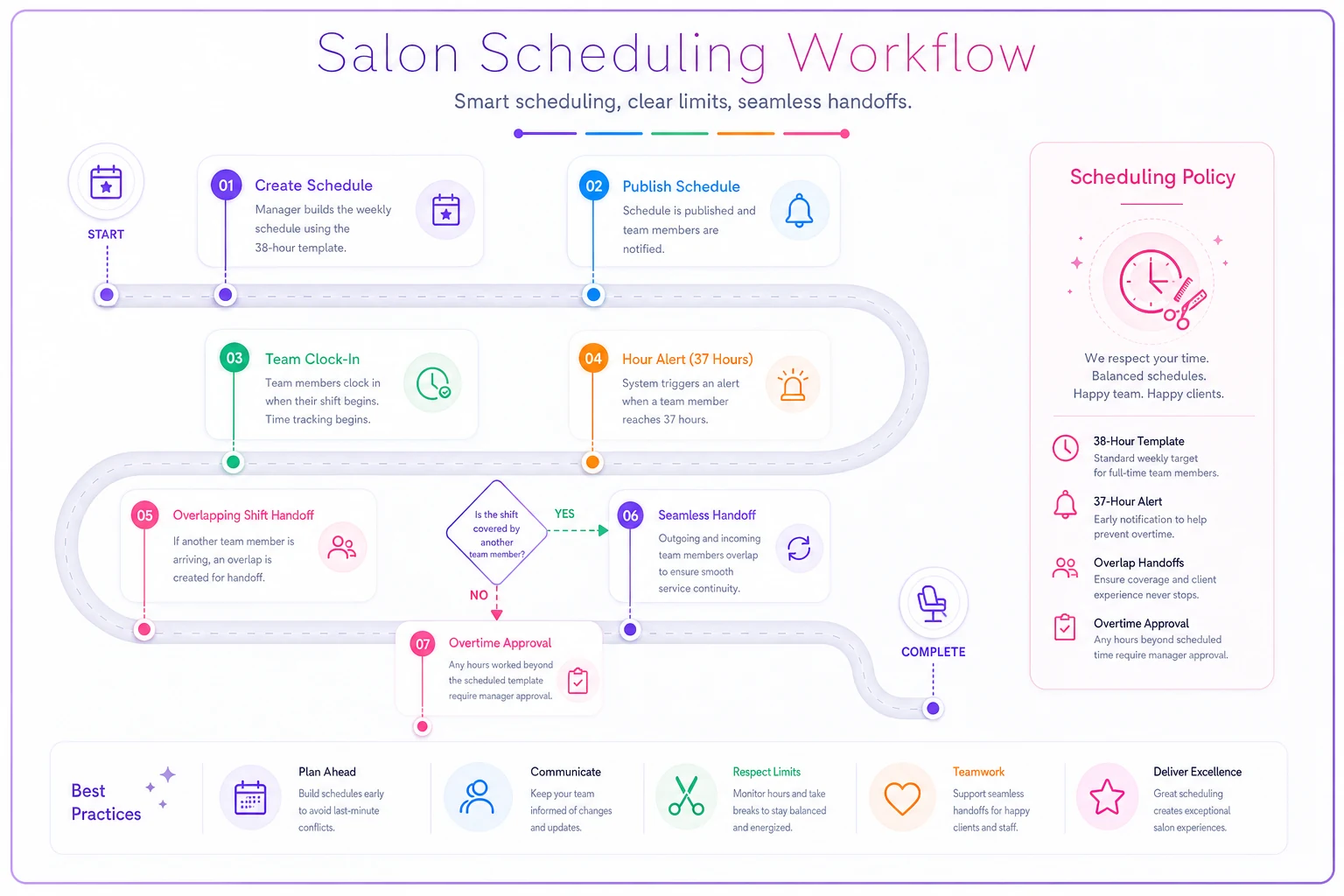
Keep the alerts and approval steps strict so schedules stop being suggestions and start being controls.
The split-shift solution nobody talks about
Traditional salon shifts run 8-9 hours straight. That made sense when you needed managers there for full coverage. But non-exempt rules change the calculation entirely.
Split shifts let you concentrate management coverage during peak periods without burning overtime. Assistant manager works 9am-1pm for the morning rush, goes home, returns 4pm-8pm for evening appointments. Eight hours of coverage targeting your busiest periods, zero overtime risk.
The psychological resistance to split shifts is real. Managers hate them. The commute time, the broken day, the difficulty planning anything else. But the economics are compelling. You can offer a small premium — maybe $2 per hour extra — for split shift work and still come out ahead versus overtime.
One salon outside Nashville restructured entirely around split shifts. Their assistant manager works Monday/Tuesday/Thursday/Friday splits, with Wednesday and weekends off. They hired a part-time supervisor for Wednesday and Saturday coverage at $18/hour, no benefits. Total additional cost: around $6,000 annually. Compared to what they were spending on overtime before? Easy decision.
The key is making split shifts predictable and consistent. Same times every day, same days every week. The unpredictability is what kills morale, not the splits themselves. Some employees actually prefer them once they adjust — errands during the day, kids' school events, gym when it's empty.
When to just pay the overtime (seriously)
Sometimes overtime is cheaper than the alternative. That sounds counterintuitive when you're trying to control costs, but the math doesn't lie.
December is the obvious example. You could hire temporary help for the holiday rush, but between recruiting, training, and mistakes, you might spend more than just paying your experienced assistant manager overtime for a few weeks. A trained manager working overtime still performs better than a temp learning your systems.
The calculation: Overtime for 10 hours weekly for 3 weeks at $36/hour = around $1,100. Hiring temp coverage at $20/hour for 30 hours, plus 10 hours training, plus inevitable errors and slower service? Easily exceeds $1,500, and you get worse results.
Special events follow the same logic. That bridal party booking eight stylists on a Sunday? Pay the overtime for your assistant manager to coordinate rather than trying to run it yourself or trusting a junior employee. The revenue from a big booking justifies modest overtime costs.
But salons mess up by not tracking which overtime is profitable and which is waste. Overtime for a wedding party that generates thousands? Good investment. Overtime because you didn't schedule properly on a slow Tuesday? Pure waste.
Create an "approved overtime" list. Holiday weeks, special events, emergency coverage for genuine emergencies (not poor planning). Everything else requires owner approval before the hours are worked, not after. This distinction helps managers understand when flexibility makes business sense versus when it's just poor scheduling.
The part-time puzzle: building coverage without benefits triggers
Under the new FLSA salary change, your instinct might be to convert everyone to hourly and carefully manage hours. But there's a smarter play: strategic part-time hiring that avoids both overtime and benefit triggers.
Most salons need 50-60 hours of management coverage weekly. Instead of one person working 50+ hours (hello, overtime), split it between an assistant manager at 38 hours and a shift lead at 20 hours. The shift lead handles basic supervision — checking in stylists, managing walk-ins, closing registers. They don't need the full management skillset, so you can pay them less per hour.
The coverage map looks like this:
Assistant Manager (38 hours):
-
Core business hours
-
Inventory management
-
Staff scheduling
-
Client escalations
Shift Lead (20 hours):
-
Saturday coverage
-
Evening closings
-
Break coverage
-
Basic operations
Keep everyone under 30 hours to avoid ACA requirements, under 40 to avoid overtime. Two part-timers at 25 hours each costs less than one full-timer at 50 hours with overtime, plus you get scheduling flexibility and coverage redundancy.
But watch for constructive dismissal claims. If someone was full-time and you suddenly cut them to 25 hours to avoid overtime, that's potential legal trouble. Better to hire new part-timers for the split roles than to drastically cut existing employees' hours.
Reclassification without the revolt
The conversation where you tell someone they're now hourly instead of salaried? That's where everything can go sideways. Employees hear "demotion" even when their pay stays the same.
A salon owner I know completely botched this last week. Walked in Monday morning, announced the assistant manager was now hourly, would need to clock in and out, and couldn't work over 40 hours. The assistant manager quit on the spot, taking two stylists with her.
Here's how you actually do it:
Start with the numbers. Show them exactly what they'll make hourly based on their current salary. If they made $48,000 salary, that's $23.08 hourly. For a typical 38-hour week, they're looking at $877 weekly, or roughly $45,600 annually. Slightly less, yes, but frame it as "protecting their work-life balance" by ensuring they don't work unpaid overtime anymore.
Then add sweeteners. Maybe they get a percentage of retail sales during their shifts. Or first pick of vacation weeks. Or a guaranteed annual review for raises. Something that shows this isn't a demotion, just a classification change required by law.
According to employment law firm Littler's analysis, the key is positioning this as a compliance requirement, not a performance issue. You're not reclassifying because they did something wrong — the government changed the rules.
The timeline matters too. Don't spring it on them. Give two weeks notice before the change takes effect. Let them ask questions, voice concerns, understand the new structure. Rushed reclassifications lead to confusion, resentment, and usually someone important walking out.
Scheduling software isn't optional anymore
Manual scheduling when everyone's exempt is annoying but manageable. Manual scheduling with overtime-eligible managers is financial suicide.
You need three things minimum: time tracking that prevents unauthorized overtime, schedule templates that automatically flag when someone exceeds 40 hours, and real-time labor cost visibility. Not having these isn't just inefficient — it's genuinely risky when every scheduling mistake costs time-and-a-half.
Most salon scheduling happens in spreadsheets or paper books. Your assistant manager stays fifteen minutes late three days in a row? Nobody notices until payroll, when that forty-five minutes of overtime is already locked in. Multiply that by every week, every non-exempt employee, and you're hemorrhaging money you don't even see.
Use scheduling software that blocks shift pickups pushing someone into overtime unless there's an explicit approval step.
Modern scheduling platforms catch these issues before they happen. Someone approaching 38 hours on Thursday? The system alerts you. Someone trying to pick up a shift that would put them into overtime? Blocked automatically unless you override it. The upfront cost feels expensive until you calculate how much overtime you're preventing.
The real value comes from pattern recognition. Which shifts consistently run over? When do you actually need coverage versus when you're overstaffed? That Saturday morning shift you've been staffing with your assistant manager might not need management coverage at all — the data would show minimal activity until 11am.
Protecting margins with tiered responsibility
Not every task needs manager-level pay. That's obvious, but most salons operate like it's not true. Your assistant manager spending two hours daily checking in retail inventory? That's not a management task.
Break down every management responsibility by complexity and required authority. Scheduling stylists requires understanding everyone's skills and client relationships — that's management level. Counting shampoo bottles and placing orders from a preset list? That's entry-level admin.
A realistic breakdown:
True Management Tasks ($24/hour):
-
Staff discipline and coaching
-
Schedule creation and optimization
-
Client complaint resolution
-
Financial reporting review
-
Interview and hiring decisions
Supervisor Tasks ($18/hour):
-
Opening/closing procedures
-
Break coverage
-
Basic problem-solving
-
Supply ordering from preset lists
-
Daily cash reconciliation
Admin Tasks ($14/hour):
-
Appointment confirmation calls
-
Inventory counts
-
Data entry
-
Filing and organization
-
Retail display maintenance
| Role and Rate | Tasks |
|---|---|
| True Management Tasks ($24/hour) | Staff discipline and coaching; Schedule creation and optimization; Client complaint resolution; Financial reporting review; Interview and hiring decisions |
| Supervisor Tasks ($18/hour) | Opening/closing procedures; Break coverage; Basic problem-solving; Supply ordering from preset lists; Daily cash reconciliation |
| Admin Tasks ($14/hour) | Appointment confirmation calls; Inventory counts; Data entry; Filing and organization; Retail display maintenance |
Once you map this out, you realize your assistant manager is doing maybe 20 hours of actual management work weekly. The other 20 hours? Lower-level tasks that inflated their role and, under the old salary rules, didn't matter because they were exempt anyway.
The restructure becomes obvious: Assistant manager focuses purely on management tasks for 25-30 hours weekly. Hire a part-time admin for 20 hours to handle the basic stuff. Total labor cost might actually decrease while everyone's doing more appropriate work.
This connects directly to the tiered pricing and rostering model we've covered before — you're already thinking about skill levels for stylists, now apply the same logic to administrative roles.
The contractor conversion trap
Desperate to avoid overtime and benefits, some salons are trying to convert everyone to 1099 contractors. Stop. That's not how employment law works, and the penalties will destroy your business.
Your assistant manager who works set hours, uses your scheduling system, follows your procedures, and manages your staff? They're an employee. Calling them a contractor doesn't make it true. The IRS and DOL look at actual working relationships, not what you write on paperwork.
One salon in Phoenix tried this last year. Converted three managers to "independent contractors" but kept everything else identical — same schedules, same responsibilities, same everything except the tax classification. Six months later, they got hit with nearly $50,000 in back payroll taxes, penalties, and interest. The salon closed within three months.
The legitimate contractor model only works for true independent operators. That stylist who rents a chair, brings their own clients, sets their own hours, and uses their own products? Contractor. Your assistant manager who runs daily operations? Employee, period.
If you're considering contractors, ask yourself: Could this person do the same job for my competitor tomorrow without any changes? If no, they're probably an employee. Could they refuse shifts or set their own schedule? If no, definitely an employee. Do they manage other employees? Almost certainly an employee.
Three schedules that work post-FLSA change
Forget theoretical frameworks. Here are three battle-tested schedules that keep salons profitable after FLSA salary change reclassification:
Schedule A: The Overlap Model
-
Assistant Manager
Mon-Fri, 10am-6pm (38 hours)
-
Shift Lead
Wed-Sun, 12pm-5pm (25 hours)
-
Owner coverage
Saturday morning, Sunday if needed
This creates Wednesday-Friday overlap for training and complex tasks while maintaining coverage seven days without overtime. Works best for salons open Sunday or with heavy weekend business.
Schedule B: The Split Coverage Model
-
Senior Manager
Mon/Tue/Thu/Fri, 8am-6pm (36 hours)
-
Junior Manager
Wed/Sat/Sun, 9am-6pm (24 hours)
-
Part-time admin
Floating 15 hours for gaps
Each manager owns specific days completely, reducing handoff confusion. The senior manager handles the business-heavy weekdays, junior gets weekends plus Wednesday for mid-week coverage.
Schedule C: The Compression Model
-
Manager
Four 9.5-hour days (38 hours)
-
Supervisor
Three 8-hour days (24 hours)
-
Owner
Fills gaps, typically 15-20 hours operational work
Manager works Mon/Tue/Thu/Fri with Wednesday off, creating a natural mid-week break that reduces burnout and overtime risk.
Each model assumes roughly 60-65 hours of total management coverage weekly — enough for most mid-size salons without hitting overtime triggers. The key is picking the model that matches your peak hours
Each model assumes roughly 60-65 hours of total management coverage weekly — enough for most mid-size salons without hitting overtime triggers. The key is picking the model that matches your peak hours
Ready to simplify your salon operations?
Join 1,000+ salons using Salnly to save time, reduce scheduling chaos, and deliver better client experiences.