

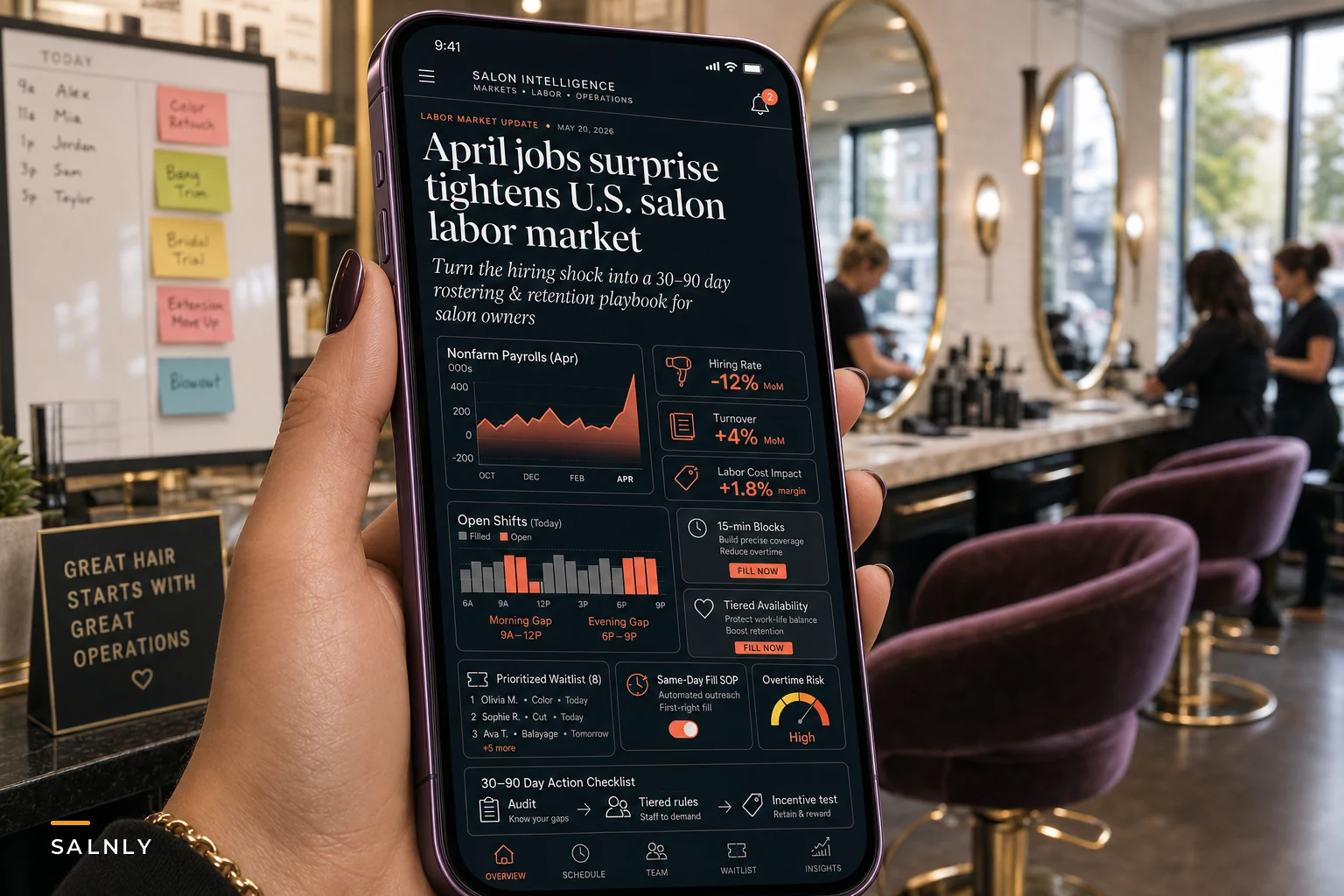

The April jobs report landed like a scheduling nightmare on a Saturday morning. According to Reuters, employers added more jobs than anyone expected while unemployment sat steady at 4.3%. For salon owners managing hourly teams, this means your best colorist just got three job offers this week, and your junior stylist is ghosting shifts to interview at the new blowout bar downtown.
Most owners respond by throwing money at the problem—matching offers, bumping commission rates, adding random perks—without fixing the underlying operational mess that makes their salon harder to work at than it needs to be. Last month I watched a salon in Austin lose four stylists in two weeks. Not because of pay. The competing salon down the street offered the same commission structure. The difference? One salon had their scheduling together, and one didn't.
The hidden cost calculation your stylists are already making
Your stylists aren't just comparing hourly rates or commission percentages anymore. They're doing complex mental math about their actual take-home potential, and most salon owners don't realize this calculation happens every day.
Base pay is only the starting point. A stylist making $18/hour plus tips at your salon might jump to a place offering $16/hour if that second salon guarantees fuller books. Six clients at $16 beats four clients at $18 every time. Schedule stability matters now. That new medical spa offering guaranteed hours looks amazing compared to your feast-or-famine booking patterns. They're calculating predictability into their compensation, not just potential earnings.
The overhead time factors in too. If your check-in process takes 15 minutes per client while the salon next door streamlined theirs to 5 minutes, that's an extra client they can squeeze in per day. More clients equals more tips, even at the same base rate.
Walk-in chaos impacts their decision. When your front desk can't manage walk-ins smoothly, stylists lose tips from rushed services or angry clients. They know which salons handle this better. Transportation costs hit different in a tight labor market. That extra $2/hour means nothing if the commute adds 40 minutes each way. Stylists are mapping drive times against hourly differentials now.
Many of these problems are fixable with better operational systems, but owners keep focusing on the wrong metrics.
Why traditional retention tactics fail when everyone's hiring
Signing bonuses stopped working. I watched a chain salon offer $1,500 signing bonuses last quarter, only to see those same stylists leave after exactly 90 days (when the clawback period ended). They pocketed the bonus and moved to competitors offering the same deal.
Stop losing appointments in the chaos.
Salnly helps you book, confirm & manage every appointment—efficiently.
- Centralized appointment management
- Client notifications
- Calendar & staff scheduling
No credit card required
Pizza parties and "team building" events get eye rolls now. Your stylists need rent money, not awkward icebreakers. One salon owner spent $800 on a team appreciation dinner while her stylists secretly interviewed because she couldn't guarantee consistent weekly hours. The "we're a family" message sounds hollow when you're cutting hours. Stylists see through this immediately. Family doesn't reduce your shifts when bookings slow down.
Even traditionally effective retention tools are losing power. Flexible scheduling used to be a major perk—now every salon offers it because they're desperate for coverage. Advanced education budgets help, but stylists know they can get that anywhere in this market.
What actually moves the needle: operational excellence that makes their job easier and more profitable.
Building a rostering system that actually protects you
Most salons roster backwards. They look at who's available and try to fill spots. In a tight labor market, you need to flip this entirely and roster based on protection, not just coverage.
Start with your non-negotiables. These are the shifts that absolutely must have experienced coverage, no matter what. Usually Saturday 10am-3pm, Thursday evenings, and whatever your highest-revenue service windows are. Lock these down with your most reliable stylists first. Then layer in your flexibility zones. These are times when you can absorb a call-out without destroying the day. Maybe Tuesday afternoons or Wednesday mornings when you typically run lighter. This is where you schedule newer team members or those with inconsistent attendance.
Create coverage redundancy for high-risk periods. If you know Saturday mornings are prone to no-shows, schedule one extra person on Friday nights. Yes, you might run slightly heavy on labor some weeks, but it beats turning away walk-ins because half your team called out.
Build in skill overlap strategically. Don't schedule all your colorists on the same day. Spread specialized skills across the week so losing one person doesn't eliminate an entire service category. The protection roster isn't about having more people—it's about having the right people in the right slots with built-in backup plans.
The three-tier availability system that reduces call-outs
Traditional availability is binary: you're either working or you're not. But stylists' actual availability is way more nuanced, especially when they're juggling multiple opportunities.
Implement three availability tiers instead:
-
Tier 1
Guaranteed shifts.
These are the stylists' locked-in, absolutely-will-be-there shifts. They commit to these no matter what. In exchange, you guarantee these hours even if bookings are light. Both sides have skin in the game. -
Tier 2
Preferred availability.
The stylist wants these shifts and will usually take them, but they need flexibility for life stuff. You can schedule them here but have backup plans ready. They get first dibs on these slots, but no guarantee. -
Tier 3
Emergency only.
These are stylists who can't commit to regular shifts but will jump in during crises. Maybe they're in school, have another job, or are semi-retired. You only call them when you're desperate, but they're gold when you need them.
This system acknowledges reality: not everyone has the same commitment level, and that's actually fine if you plan for it. A salon in Denver implemented this and saw call-outs drop by about 40% in two months. Stylists weren't overpromising anymore. They could be honest about their actual availability without losing hours entirely.
Respect the tiers. Don't guilt Tier 3 people into regular shifts. Don't treat Tier 1 people like they're on-call 24/7. Let people self-select their commitment level and adjust your expectations accordingly.
Micro-scheduling rules that maximize earnings (and keep stylists happy)
In a tight labor market, stylists stay where they make the most money per hour actually worked. Not scheduled—worked. This distinction matters more than most owners realize.
The standard approach of booking stylists in solid blocks creates dead time that kills their hourly earnings. A stylist scheduled 9-5 with three appointments clustered in the morning sits around for two hours making nothing. They know they could've picked up shifts elsewhere during that dead time. Here's a micro-scheduling approach that works:
Book in service clusters, not time blocks. Instead of scheduling a stylist for "Tuesday 10-6," schedule them for specific service clusters. "Tuesday: 10am color, 12pm cuts block, 3pm color." If those are their only bookings, they can leave between clusters.
This sounds chaotic, but stylists love it when you systematize it properly. They're making the same money in less time, which effectively raises their hourly rate without costing you more. Create 15-minute float zones between appointments. Not for buffer time—for add-on opportunities. Quick bang trims, beard cleanups, product consultations. These micro-services add $15-30 to their tickets without requiring full appointment slots.
Let stylists "claim" walk-in windows. Instead of randomly assigning walk-ins, let stylists claim specific windows where they want extra work. "I'll take any walk-ins between 2-4pm today." They're mentally prepared and actually want the work.
Synchronize chemical processing times. If two stylists both have color clients, start them 20 minutes apart. While one processes, the other can take a quick walk-in cut. This coordination requires planning but dramatically improves utilization. The difference this makes is striking. One salon saw average stylist utilization jump from around 65% to nearly 80% just by restructuring how they scheduled. Same hours, same services, but way better earnings for stylists.
Reserve a consistent 15-minute add-on slot between clusters to increase ticket average without disrupting flow.
The standard approach of booking stylists in solid blocks creates dead time that kills their hourly earnings. A stylist scheduled 9-5 with three appointments clustered in the morning sits around for two hours making nothing. They know they could've picked up shifts elsewhere during that dead time. Here's a micro-scheduling approach that works:
Creating financial incentives that actually change behavior
Money motivates, but only when the incentive structure makes sense. Most salon bonus systems are either too complicated or too far removed from daily actions to change behavior.
The ineffective approach: "If we hit $50K in monthly revenue, everyone gets a $200 bonus." This creates zero urgency day-to-day. Stylists can't connect their Tuesday afternoon effort to a month-end number. Better incentive structures tie rewards to immediate, controllable actions:
Daily achievement bonuses work. "Book 6 clients today, earn an extra $25." Simple, clear, achievable. Stylists know exactly what to do and get rewarded same-day or next-day.
Service upgrade micro-bonuses change behavior fast. "$5 for every conditioning treatment add-on." Suddenly stylists remember to mention that dry hair needs treatment. Fill-the-gap rewards solve scheduling problems. "Take a last-minute booking to fill a cancellation: extra $10." This incentivizes flexibility when you need it most.
Team-based hourly bonuses for busy periods. "If we maintain sub-20-minute wait times on Saturday, everyone working gets $15/hour extra for those hours." This makes the whole team care about efficiency during rush periods. Make the connection between action and reward impossible to miss. Complex percentage-based calculations that pay out quarterly don't change Tuesday afternoon behavior.
The Wednesday morning test (know if your rostering actually works)
Here's a brutal reality check that tells you if your rostering system actually works: what happens at 9am on a random Wednesday when someone calls out?
Most salons fail this test spectacularly. The manager starts frantically texting, begging people to come in, offering random bonuses, and ultimately either running short-staffed or calling in someone who's already worked six days straight. A functional rostering system handles this without drama:
You already know who your Wednesday morning backup options are because you've mapped availability properly. You're not discovering this information during the crisis. Your backup stylists actually answer because you've maintained the relationship. They're not getting their first text from you in three months asking for emergency help.
The financial hit is predictable and acceptable. You know exactly what it costs to call in emergency coverage because you've standardized those rates, not negotiated them in panic mode.
Clients barely notice the adjustment. Your team knows how to redistribute bookings, your front desk has scripts ready, and service continues smoothly. One salon in Portland tracks their "Wednesday morning score"—how many minutes it takes to secure coverage for an unexpected call-out. They've gotten it down from 90+ minutes of chaos to under 15 minutes of systematic response.
That's the difference between a rostering system and just having a schedule.
Building your 30-day staffing stabilization plan
Fixing salon staffing problems requires systematic changes, not desperate scrambling. Here's a practical 30-day timeline:
| Days | Action |
|---|---|
| Days 1-7: Audit your actual problem | Stop assuming you know why stylists leave or no-show. Track every call-out, late arrival, and resignation. Note the stated reason and the real reason (they're different). Map when coverage gaps actually hurt vs. when you just ran heavy. Calculate what instability actually costs—usually around $2,800-$4,200 monthly for a 6-chair salon. |
| Days 8-14: Fix the obvious operational friction | Before you touch compensation, eliminate the daily annoyances that make stylists' jobs harder. Fix the scheduling software that double-books. Stop the product shortages that force stylists to apologize to clients. Repair the broken hair dryer that's been broken for three months. These seem minor but they add up to stylists feeling disrespected. |
| Days 15-21: Implement graduated availability | Roll out the three-tier system gradually. Start by having honest conversations with each stylist about their actual availability. Don't force anyone into a tier—let them self-select. You'll be surprised how many people appreciate being able to say "I can only guarantee Tuesdays and Thursdays" without losing work entirely. |
| Days 22-30: Test new incentive structures | Pick one simple daily incentive and test it for a week. Track if behavior actually changes. A salon in Nashville tested "$3 per retail item sold" and saw retail jump 40% in five days. Another salon tried the same thing and saw no change—their issue was inventory, not motivation. |
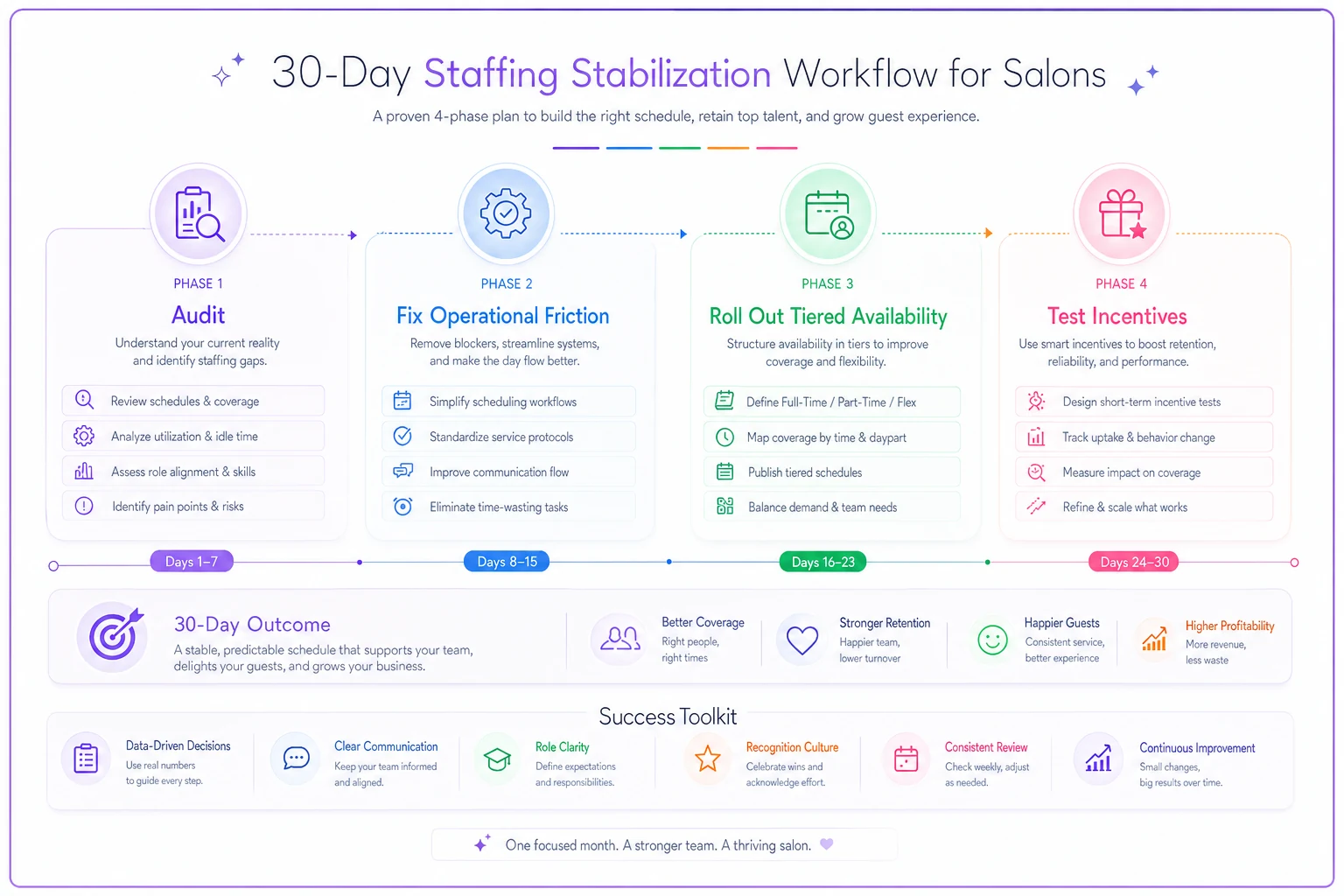
This visual highlights the sequence of actions across the 30 days.
When throwing money at the problem makes sense (and when it doesn't)
Sometimes you actually do need to increase compensation. But most owners do it wrong—they panic-raise everyone's pay without fixing the underlying issues.
Raise pay when your rates are genuinely below market (check Indeed, not just what other owners tell you), you're losing stylists specifically to higher-paying positions (not just "better opportunities"), or the role has genuinely become more demanding (like after adding new services).
Don't raise pay when you haven't fixed operational basics first, you're trying to retain someone who's already decided to leave, or you're matching an offer from a fundamentally different business model (like medical spas paying W2 wages vs. your commission structure).
The math on retention spending is usually clear. It costs roughly $3,000-$5,000 to replace an experienced stylist when you factor in recruiting, training, and lost revenue during ramp-up. Spending $2,000 annually in retention efforts per stylist usually pays for itself. But that money needs to go toward systematic improvements, not desperate counter-offers.
Converting chaos into predictable coverage
The salons surviving this labor squeeze aren't the ones paying the most. They're the ones that made their operations so smooth that stylists don't want to leave even when someone offers more money.
This isn't about building some perfect utopian workplace. It's about removing the daily friction that makes stylists start scrolling job listings on their lunch breaks. When stylists know their schedule three weeks out, when the booking system doesn't randomly lose appointments, when they can actually take their breaks, when someone handles walk-ins competently—that's when retention becomes automatic rather than a constant battle.
The labor market will stay tight. Competition for skilled stylists will continue. But salons with their operational foundation solid will weather this while others scramble. Similar to the FLSA scheduling challenges we covered last month, the answer isn't throwing resources at the problem—it's building systems that make the problem manageable.
This operational excellence becomes even more powerful when you centralize it through proper workflow management. AI-powered platforms now handle the complex availability mapping, automatic backup scheduling, and incentive tracking that used to require hours of manual management time. But whether you're using spreadsheets or sophisticated software, the principles remain: protect your core coverage, respect real availability, and eliminate the operational friction that sends stylists looking elsewhere.
The salons that thrive in this tight labor market won't be the ones paying the most. They'll be the ones that make working there genuinely easier and more profitable than working anywhere else. And that's an operational problem with an operational solution.
Ready to simplify your salon operations?
Join 1,000+ salons using Salnly to save time, reduce scheduling chaos, and deliver better client experiences.