

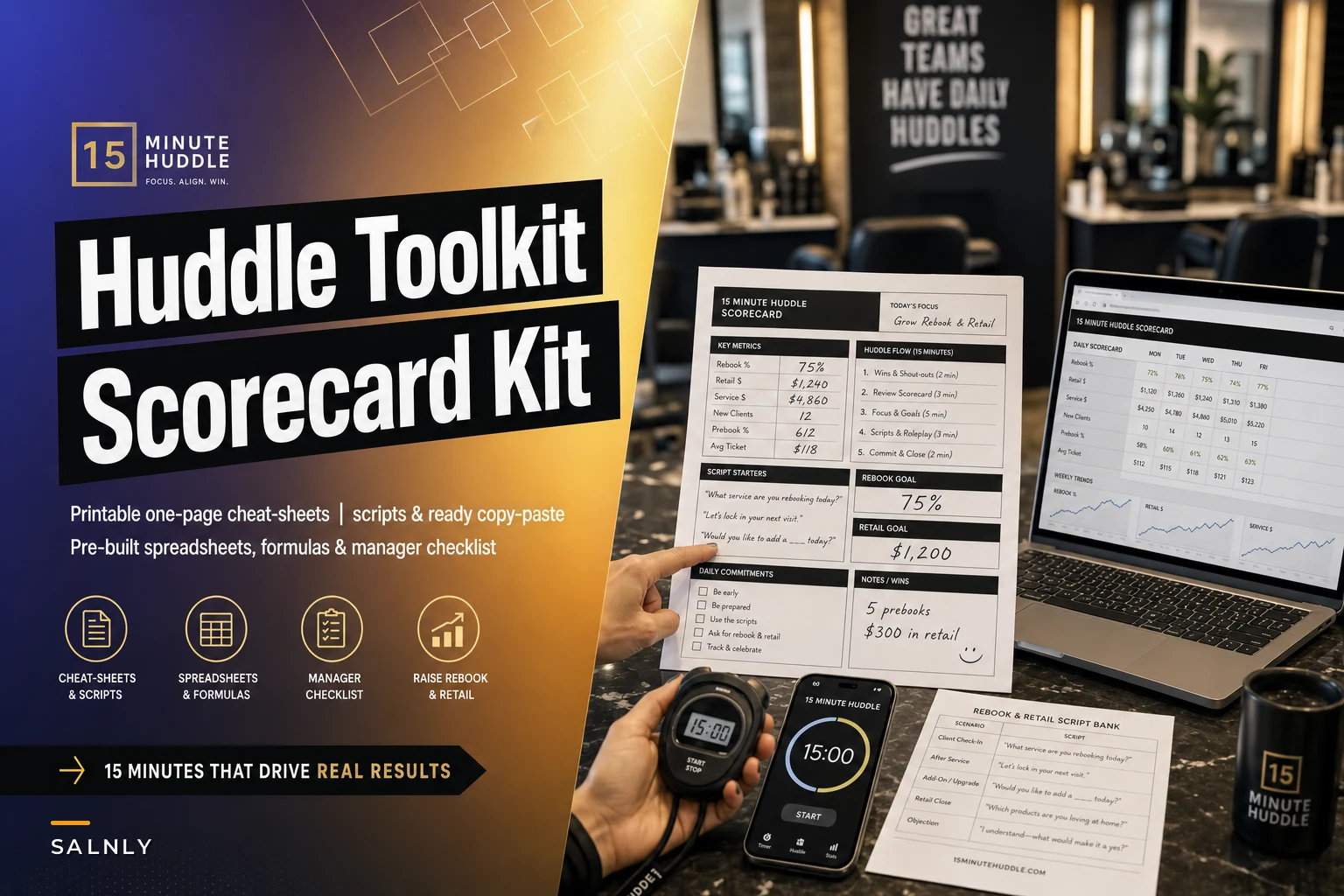

The hardest part of a daily huddle isn't deciding to do one. It's the Tuesday three weeks in, when your front desk is slammed, two stylists are running late, and the manager quietly skips it "just for today." That's where huddles die. Not from a bad idea — from missing the small operational pieces that make them survive a busy week.
This is the companion kit to the parent piece on the 15-minute salon huddle, scorecard and corrective-conversation toolkit. Everything below is built to be printed on one page or copy-pasted straight into whatever you already use. No theory. Just the sheets, scripts, formulas, and the enforcement language that keeps the whole thing from falling apart.
Grab what you need, skip the rest.
The minute-by-minute huddle cheat-sheet (print this and tape it near the desk)
The whole point of a cheat-sheet is that the manager shouldn't have to remember anything. Glance down, read the prompt, move on.
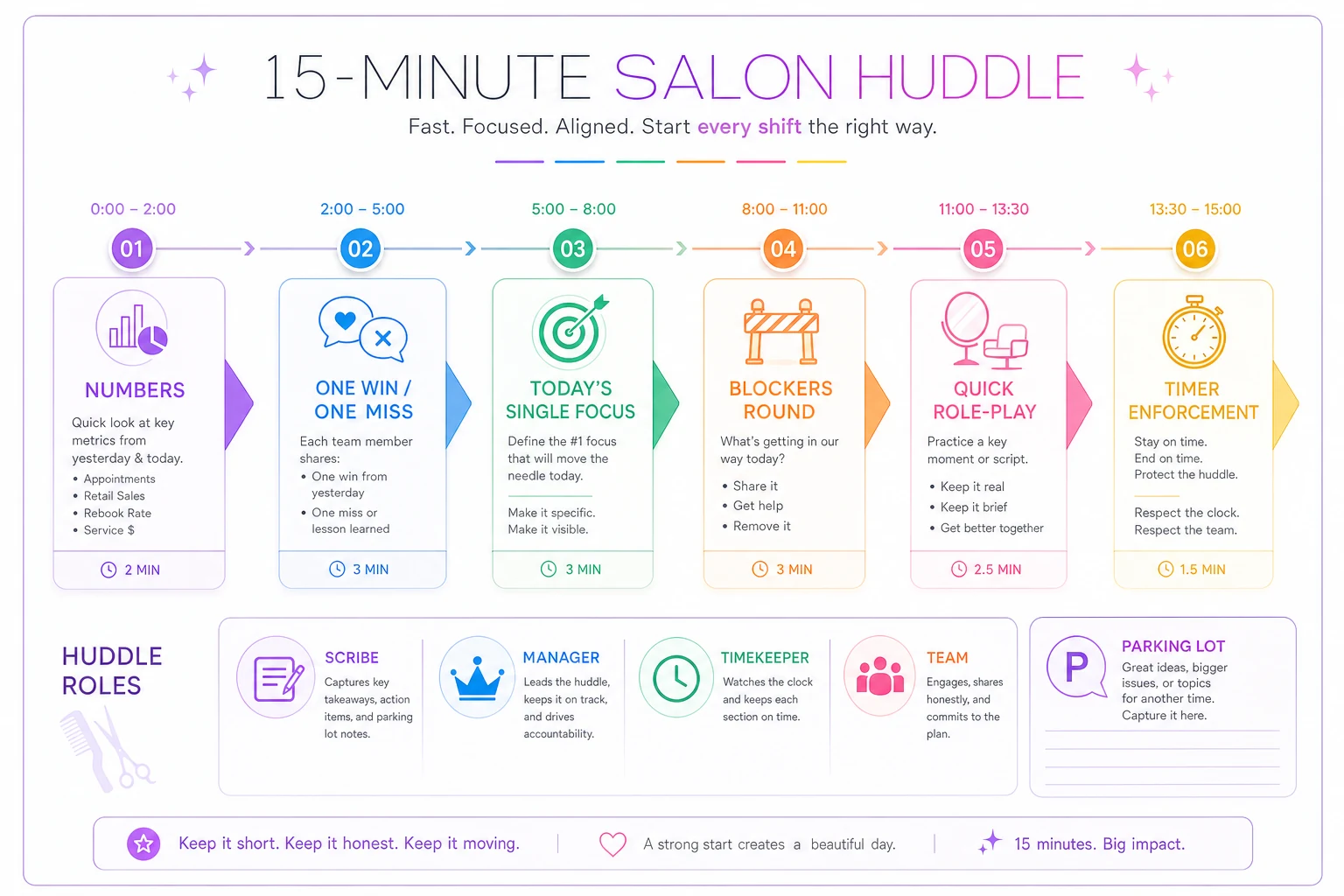
Here's the exact flow for a 15-minute cap.
0:00–2:00 — Numbers on the board (scribe reads, nobody debates yet)
> "Yesterday we did [X] services, rebook rate was [Y]%, retail attached on [Z] tickets. Green on services, yellow on rebook."
2:00–5:00 — One win, one miss (manager picks, keeps it specific)
> "Win: Maria rebooked four of her five color clients yesterday — nice. Miss: we had two 15-minute gaps on station 3 that didn't get filled."
5:00–9:00 — Today's focus (ONE number only)
> "Today the only number I care about is rebook. If you finish a cut, you ask. Every chair, every time."
9:00–12:00 — Blockers round (go around, 20 seconds each, no solving)
> "Anyone blocked? Parking lot it if it needs a real conversation — we'll grab five after."
12:00–14:00 — Role-play one line (pick a real situation)
> "Quick one. Sarah, client in your chair finished a balayage. Give me your rebook line." (let them say it, correct softly if needed)
14:00–15:00 — Close with the focus repeated
> "Rebook. Every chair. See you out there."
Here's a small visual if you want a quick reference.
Timekeeper tip: set a literal phone timer for 15:00 and let it ring. The ring is the enforcement. When people hear it cut the huddle off mid-sentence twice, they start tightening up on their own.
The printable scorecard (blank + example-filled)
Two levels: team and individual. Keep both on one page if you can — team on top, individual rows below.
Stop losing appointments in the chaos.
Salnly helps you book, confirm & manage every appointment—efficiently.
- Centralized appointment management
- Client notifications
- Calendar & staff scheduling
No credit card required
Team scorecard — blank
| Metric | Mon | Tue | Wed | Thu | Fri | Sat | Weekly |
|---|---|---|---|---|---|---|---|
| Services completed | |||||||
| Rebook rate % | |||||||
| Retail attach % | |||||||
| Avg ticket $ | |||||||
| No-shows |
Team scorecard — example-filled
| Metric | Mon | Tue | Wed | Thu | Fri | Sat | Weekly |
|---|---|---|---|---|---|---|---|
| Services completed | 38 | 41 | 44 | 52 | 61 | 68 | 304 |
| Rebook rate % | 31% | 29% | 34% | 38% | 42% | 40% | 36% |
| Retail attach % | 12% | 10% | 14% | 15% | 18% | 16% | 14% |
| Avg ticket $ | 74 | 71 | 78 | 82 | 88 | 85 | $80 |
| No-shows | 2 | 3 | 1 | 2 | 1 | 4 | 13 |
Individual scorecard — example-filled
| Stylist | Services | Rebook % | Retail attach % | Avg ticket |
|---|---|---|---|---|
| Maria | 58 | 52% | 22% | $94 |
| Sarah | 49 | 38% | 11% | $78 |
| Dev | 44 | 28% | 9% | $71 |
| Jess | 41 | 41% | 16% | $82 |
One thing worth noticing in that individual table: Dev's rebook at 28% isn't a motivation problem, it's almost always a timing problem — they're asking at checkout instead of in the chair. The scorecard's job is to surface that, not to shame Dev in front of the team.
The formulas (drop these straight into Sheets or Excel)
These are the exact metric definitions so everyone calculates the same way. The most common mess is two people defining "rebook rate" differently — one counts clients who rebooked within 48 hours, another counts anyone who books again ever. Pick one and lock it.
Assume columns: A = date, B = services completed, C = clients who rebooked before leaving, D = tickets with retail, E = total retail $, F = total service $.
-
Rebook rate
=C2/B2→ format as % -
Retail attach rate
=D2/B2→ format as % -
Avg ticket
=(E2+F2)/B2 -
Retail $ per service
=E2/B2 -
Weekly rebook rollup
=SUM(C2:C7)/SUM(B2:B7) -
Trend arrow (vs last week)
=IF(thisweek>lastweek,"▲",IF(thisweek<lastweek,"▼","—"))
Pre-filled example row so you can sanity-check the sheet:
2024-05-14 | 44 | 15 | 6 | 190 | 3,240 → rebook 34%, attach 14%, avg ticket $78, retail/service $4.32.
If your numbers come out weird, it's almost always because someone logged booked appointments instead of completed ones in column B. Completed only.
Who updates what, and how often
A scorecard nobody updates is just wall decor. Assign an owner to every number. This is the single biggest reason huddles stall out — the data isn't there by 9am, so the huddle becomes guesswork.
| Metric | Frequency | Who updates | When |
|---|---|---|---|
| Services completed | Daily | Front desk (scribe) | End of day |
| Rebook count | Daily | Front desk | At checkout, tally sheet |
| Retail attach | Daily | Front desk / POS pull | End of day |
| Avg ticket | Weekly | Manager | Monday am |
| No-shows | Daily | Front desk | Rolling |
| Individual rollups | Weekly | Manager | Sunday or Monday am |
| Morale pulse | Weekly | Manager | Friday |
| NPS/CSAT | Monthly | Manager | First week |
The daily numbers should take the front desk under five minutes if they're tallying as they go. If it's taking twenty, they're reconstructing the day from memory at 7pm — fix the when, not the person.
Rebook role-play scripts (two-option phrasing)
The trick with rebook is removing the yes/no question. "Do you want to rebook?" invites a no. Two specific options invite a choice. Here's phrasing by service type.
Cut
> "Your cut's going to want a shape-up in about six weeks to keep this line clean. I've got a Thursday evening or a Saturday morning around then — which works better?"
Color / root touch-up
> "Your roots will start showing around week five or six. Want me to hold your usual Friday, or would a weekday be easier this time?"
Balayage / dimensional
> "This grows out beautifully, so you've got a little room — but to keep the blend fresh I'd see you in about ten weeks. Morning or afternoon person for that one?"
Treatment / bond repair
> "To actually see the results stack up, we'd want the next treatment in three to four weeks. I can do a quick 30-minute add-on next time you're in for a trim, or a standalone — preference?"
None of these ask if. They assume the return and offer two paths. That one shift alone is usually worth 8–12 points of rebook rate.
Retail-prescribing lines (tied to a problem, not a product)
Retail flops when stylists "sell." It works when they diagnose. Tie every line to something the client already told you or something you saw in their hair.
-
Dryness/damage "Your ends are drinking up moisture — this mask twice a week is what'll keep that balayage from going brassy early."
-
Color fade complaints "The reason your color faded by week three last time is the shampoo. A color-safe one buys you two or three extra weeks."
-
Frizz/humidity "For the frizz you mentioned, three drops of this before you dry will do more than any style will."
-
Flat/fine hair "This mousse at the root is the difference between the volume you've got right now and what you'll get at home."
The line should sound like continued care, not a pitch. If it feels like a pitch to the stylist saying it, it'll feel like one to the client hearing it.
Corrective-conversation follow-up templates
When someone's number is persistently off, the huddle is the wrong place to handle it. Pull them aside, then document. Here are three follow-up templates plus a documentation form.
Email template 1 — first supportive check-in
> Subject: Quick follow-up from our chat > Hey [name], thanks for the honest conversation today. To recap what we agreed: you'll use the in-chair rebook line on every color client this week, and we'll check your numbers together Friday. I'm here if anything gets in the way. — [manager]
Email template 2 — second conversation, firmer
> Subject: Checking in on rebook > Hi [name], we talked two weeks ago about in-chair rebooking and set a target of 35%. Last week landed at 26%. I want to understand what's blocking it — let's sit down [day] at [time]. Come with what you think is getting in the way.
Meeting-note template 3 — documented
> Met with [name] on [date]. Discussed [metric] trending below target for [X] weeks. [Name] raised [blocker]. Agreed actions: [1, 2]. Support provided: [shadow session / script card]. Review date: [date].
Documentation form (keep one per conversation)
| Field | Entry |
|---|---|
| Date | |
| Metric / issue | |
| Observations (specific, factual) | |
| Employee's input | |
| Agreed actions | |
| Support offered | |
| Review date | |
| Outcome (filled at review) |
Keep observations factual — "rebook 26% vs 35% target for three weeks," not "doesn't seem to care." Factual notes protect everyone and keep the conversation about behavior, not personality.
Manager checklist for running the huddle
Print this. Run down it before and during.
-
[ ] Scorecard updated and visible before people arrive
-
[ ] Timer set to 15
00, phone face-up
-
[ ] Timekeeper assigned (rotate weekly)
-
[ ] Scribe assigned (usually front desk)
-
[ ] One win + one miss chosen in advance
-
[ ] Today's single focus number decided
-
[ ] Parking lot sheet ready for off-topic items
-
[ ] Role-play situation picked
Latecomer script (say it once, kindly, then hold the line):
> "We start at 9 sharp so we can all get to our chairs on time. Grab the recap from [scribe] after — jumping back in."
The 15-minute enforcement paragraph (read this to the team once, then live by it): We cap the huddle at 15 minutes on purpose. The second it runs long, it stops being a huddle and becomes a meeting, and meetings are where energy goes to die. If a topic needs more than 20 seconds, it goes to the parking lot and we handle it with the two or three people who actually need to be there. Protecting the 15 minutes isn't about being rigid — it's about respecting that everyone has a client waiting. When the timer rings, we stop, even mid-sentence. No exceptions, including me.
Measuring whether the huddle actually helps morale
Rebook and retail are easy to count. Morale isn't, but you can approximate it so you're not flying blind.
Baseline (take before you start): ask three simple questions, anonymous, 1–5 scale.
-
"I know what we're focused on each day."
-
"I get useful feedback on my work."
-
"Mornings here feel organized, not chaotic."
Weekly pulse (one question, rotate):
-
"This week felt
scattered / fine / sharp"
Monthly: one CSAT item for clients ("How was your experience today, 1–5?") and one internal NPS-style question ("How likely are you to recommend working here to a friend?").
Simple correlation guidance: plot your weekly rebook rate next to your weekly pulse score for eight weeks. You're not doing statistics — you're eyeballing whether the two lines move together. If rebook climbs while morale drops, you're pushing too hard. If both climb, the huddle's doing its job. That rough visual is enough to make a call.
Setting green / yellow / red bands
Don't borrow someone else's thresholds. Set bands off your own trailing numbers so green actually means "better than our normal."
-
Pull your last 8 weeks of each metric.
-
Take the average — that's the middle of yellow.
-
Green = roughly 10% above average or your realistic stretch target.
-
Red = roughly 15% below average, the "we need to talk today" line.
Sample bands for a salon averaging 34% rebook:
| Band | Rebook | Retail attach |
|---|---|---|
| 🟢 Green | 38%+ | 18%+ |
| 🟡 Yellow | 30–37% | 12–17% |
| 🔴 Red | under 30% | under 12% |
Re-baseline every quarter. Bands that never move stop meaning anything.
Escalation matrix (objective triggers, no judgment calls)
Making triggers objective removes "the manager has it out for me" from the conversation entirely. The number crossed a line, the matrix fired. Fair because it's automatic.
| Trigger | Timeline | Action |
|---|---|---|
| Individual red 1 week | Same week | Quiet in-chair coaching, shadow a strong stylist |
| Individual red 2 weeks running | Week 2 | Documented conversation (use form above) |
| Individual red 3 weeks | Week 3 | Formal review, written action plan + review date |
| Team red 1 week | Next huddle | Diagnose as a group — usually a process issue |
| Team red 2 weeks | Week 2 | Owner reviews schedule/capacity, not just staff |
Making triggers objective removes "the manager has it out for me" from the conversation entirely. The number crossed a line, the matrix fired. Fair because it's automatic.
Pilot checklist (run it for 4 weeks before rolling out fully)
Don't launch the whole system salon-wide on day one. Pilot it.
-
[ ] Stakeholder script for the team "We're testing a 15-minute morning huddle for four weeks. It's short, it's focused, and we'll ask you at the end whether it's worth keeping. Give it a fair shot."
-
[ ] Pilot metrics rebook rate, retail attach, weekly pulse score
-
[ ] Duration 4 weeks (shorter and you can't see a trend)
-
[ ] Success criteria rebook up at least a few points, pulse score flat or up, huddle consistently under 15 min
-
[ ] Decision point keep, adjust, or drop — decided with the team, not for them
A pilot you can honestly cancel is a pilot people actually buy into. If the team thinks it's permanent no matter what, they'll just wait it out.
Remote and multi-shift adaptations
Not every team is all in one room at 9am.
Virtual huddle script (video, 10 min cap for remote):
> "Cameras on if you can. Scribe shares the board. Numbers, one win, one miss, today's focus, blockers in chat. Go."
Asynchronous board (for split shifts): keep a shared doc or whiteboard with four fixed sections — Yesterday's numbers, Today's focus, Blockers, Wins. The opening shift fills it, the closing shift reads it at their start and adds notes. No live meeting required, but the focus number carries across both shifts so you're not pulling in two directions.
What breaks async huddles is nobody reading the board. Make reading it the first thing on the shift-start checklist, same as clocking in.
Low-friction tech guidance
You don't need fancy software to start. You need the numbers to land in one place without someone retyping them.
Minimum export fields (CSV): date, stylist, servicetype, completed (Y/N), rebooked (Y/N), retailamount, service_amount
If your booking or POS system can export those seven fields, your whole scorecard builds itself with the formulas above. What you'll usually capture manually at first: the rebooked Y/N, because a lot of systems don't cleanly flag an in-chair rebook versus a later online one. A paper tally at the desk covers that gap fine until you tighten the export.
Most salon management platforms can spit out at least completed, retailamount, and serviceamount automatically — pull those, tally rebook by hand, and you've eliminated most of the manual entry on day one. Chasing a perfect automated setup before you start is the most common way owners never start at all.
Two sample filled weeks (how to actually read the trend)
Team — Week 1 vs Week 2
| Metric | Week 1 | Week 2 | Read |
|---|---|---|---|
| Rebook % | 31% | 36% | ▲ focus is landing |
| Retail attach | 13% | 12% | ▼ slipping, pick next focus |
| Avg ticket | $76 | $79 | ▲ driven by retail + rebook |
| No-shows | 14 | 11 | ▲ confirmations holding |
Coaching action from this: rebook climbed because it was the daily focus — good. Retail dipped because attention moved off it. Next week's move isn't to panic about retail; it's to rotate it back as the single focus for a few days now that rebook has momentum. One number at a time.
Individual — Dev, Week 1 vs Week 2
| Metric | Week 1 | Week 2 | Read |
|---|---|---|---|
| Rebook % | 28% | 30% | ▲ small but real |
| Retail attach | 9% | 9% | — flat |
Coaching action: Dev moved two points after one shadow session with Maria — that's a timing fix working. Keep the shadowing, don't escalate. Flat retail is the next thing to touch, but not this week. One change at a time sticks; three changes at once stick to nobody.
A quick real scenario
A two-chair-plus-front-desk salon doing roughly 300 services a month had a rebook rate stuck in the high 20s and retail barely cracking double digits. The owner wasn't missing effort — she was running long, unfocused team meetings every couple of weeks that covered everything and changed nothing.
They switched to the 15-minute format with the scorecard on the wall and one focus number a day. First month, rebook moved into the mid-30s. Retail attach crept up a few points once stylists started using the problem-tied lines instead of "do you need any product today." Average ticket rose from the mid-70s to around $80. Nothing dramatic week to week — just a steady drift upward because the team finally knew, every single morning, the one thing that mattered that day.
The part the owner didn't expect: the morale pulse went up, not down. Short and focused felt less stressful than long and vague. A tight daily rhythm reads as respect for people's time, and people respond to that more than to any pep talk.
Print what's useful, ignore what isn't, and start Monday. The toolkit only works if it's on the wall — not in a tab you'll reopen "later." If you want the full reasoning behind why this format beats the standard team meeting, the parent breakdown on the 15-minute huddle and corrective-conversation toolkit walks through it.
Ready to simplify your salon operations?
Join 1,000+ salons using Salnly to save time, reduce scheduling chaos, and deliver better client experiences.