

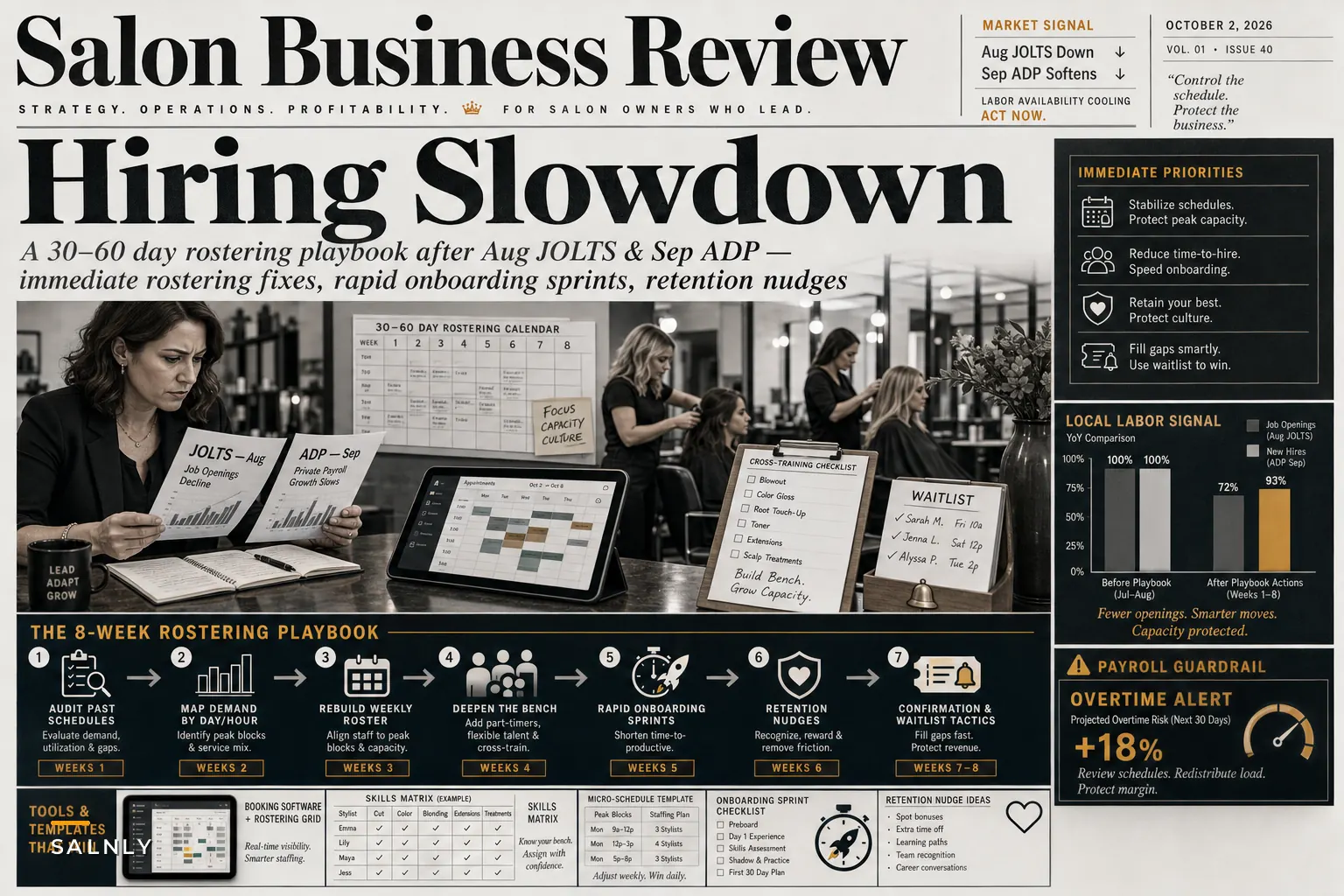

Two numbers landed in the last 48 hours that most salon owners probably scrolled past. The Bureau of Labor Statistics reported that job openings held roughly steady at 7.1 million in August, with layoffs staying low. Then the next morning, ADP data showed private payroll growth actually picked up in September. On the surface those two things look like they cancel each other out — openings cooling, hiring warming.
But if you run a salon, that mixed signal is one of the more useful setups you'll get all year. It tells you the labor market is loosening without breaking. A short, specific window where you can fix your roster, your bench depth, and your retention habits before the next shift — and the next shift usually isn't in your favor.
This isn't really about the economy in the big-picture sense. It's about what the economy lets you get away with for the next 30–60 days.
Why this particular data mix matters for a salon floor
Most salon staffing advice treats the labor market as either "impossible to hire" or "easy to hire." Reality is almost never that clean. Right now you've got a situation where candidates are more available — cooling openings means fewer employers competing for the same stylist — but people aren't getting laid off either, so your existing team isn't panicking or job-hopping out of fear.
-
You can probably fill an open chair faster and at a saner wage than you could six months ago.
-
Your existing stylists are less likely to be actively shopping offers, which buys you time on retention.
-
Clients aren't cutting back dramatically — payroll growth generally means consumer spending holds, so your demand side isn't collapsing.
That combination is rare. And it doesn't last. These windows typically close within a quarter or two, and when they do, the availability side usually pivots first — the stylist you could've hired in October wants $4–6 more an hour by February, or isn't available at all.
So the real question isn't "should I hire?" It's "what do I lock in while the cost of being wrong is low?"
The problem this exposes: most salons roster around people, not demand
Most salons build their schedule around who they have, not what the week actually needs. The roster ends up being a reflection of whoever's been there longest and whoever asked for which days.
Stop losing appointments in the chaos.
Salnly helps you book, confirm & manage every appointment—efficiently.
- Centralized appointment management
- Client notifications
- Calendar & staff scheduling
No credit card required
That works fine when the labor market is stable. It falls apart during any shift — hiring or firing — because you have no baseline to measure against. You can't tell if you're overstaffed on Tuesdays or dangerously thin on Saturday afternoons, because the schedule was never built from demand in the first place.
In practice, this shows up as two expensive patterns running at the same time:
-
Paid idle time. A senior stylist sitting through a dead Wednesday morning at full wage because that's "their day."
-
Turnaway demand. A fully booked Friday evening where you're sending three or four color clients to a competitor because nobody with the right skill set is scheduled.
Both are happening in the same salon, in the same week. The owner usually only notices the first one because it shows up on payroll. The second one never shows up anywhere — it's revenue that silently doesn't exist.
A loosening labor market makes this worse in a sneaky way. When hiring feels easy, owners tend to add heads to fix the Friday problem — then they're stuck carrying that extra wage through slow Tuesdays indefinitely. You solve a demand problem with a permanent cost.
A quick comparison: hiring-reactive vs. demand-first rostering
Demand-first rostering isn't complicated in concept — it just requires deciding what the week needs before deciding who works it. Most salons never do that step, and the cost difference between these two approaches adds up fast.
| Situation | Hiring-reactive salon | Demand-first salon |
|---|---|---|
| Friday is overbooked | Hires a new full-timer | Shifts existing senior hours into peak blocks first, adds part-time coverage only for the gap |
| Tuesday morning is dead | Eats the idle wage | Rosters lighter, uses the slot for training or admin |
| A stylist gives notice | Scrambles, overbooks remaining staff | Pulls from a pre-vetted bench, ramp already planned |
| Labor market loosens | Adds heads "while it's cheap" | Deepens the bench, keeps core roster lean |
| Wages tick up | Overpays to retain the headcount it over-hired | Protected margin, fewer bodies to cover |
The difference isn't effort. It's sequence. Demand-first salons decide what the week needs before they decide who works it. Running this comparison against your own roster is usually enough to show you where the money is leaking.
The 30–60 day playbook
You don't need to overhaul anything. You need to do four things in order over the next two months.
Here's a simple visual workflow to follow over the next 60 days.
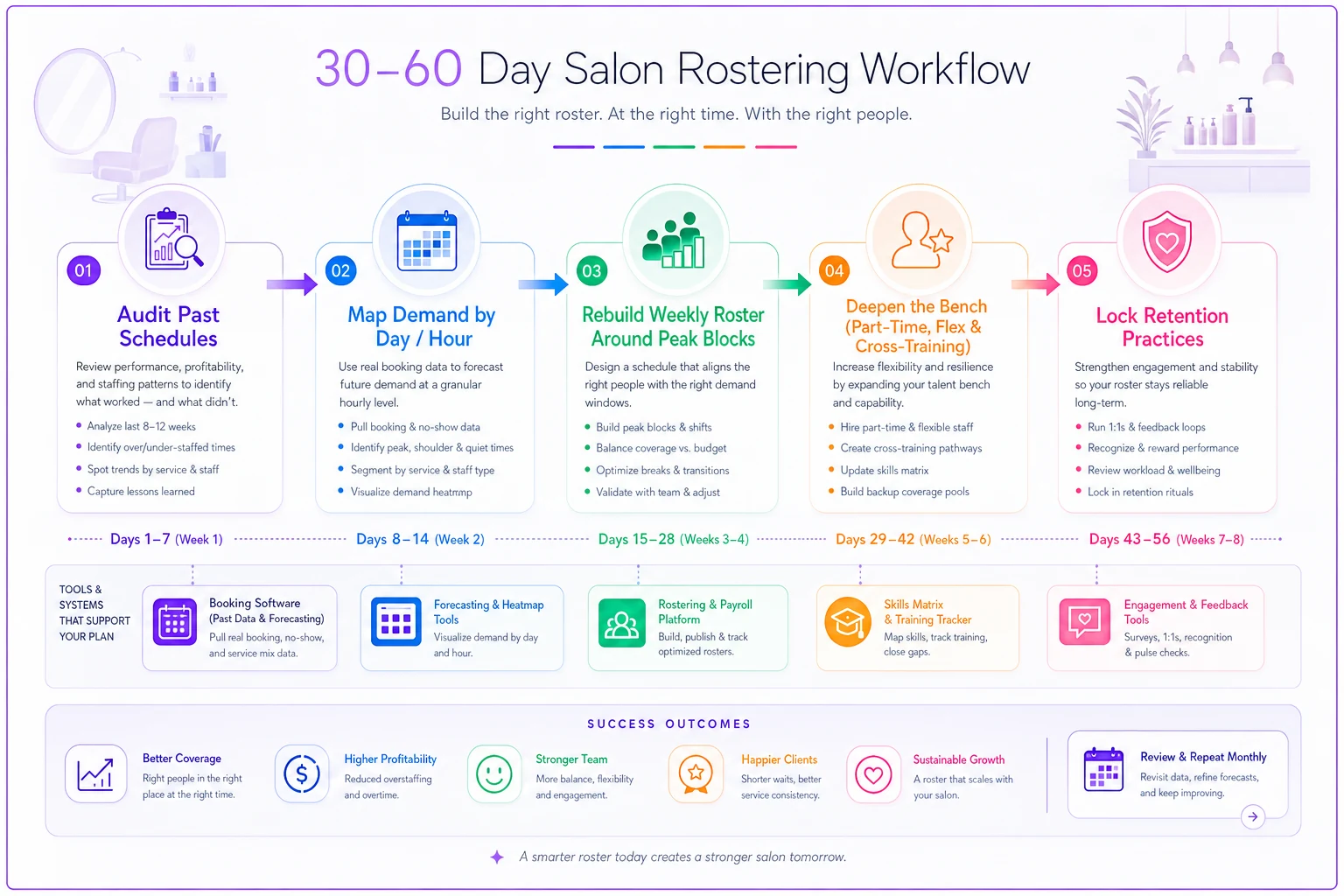
1. Run an open-shift and overtime audit (Week 1–2)
Pull the last 8–12 weeks of your actual schedule against actual bookings. Not what you planned — what happened. You're looking for three things:
-
Hours worked with low utilization. Any block where a stylist was on the clock but under roughly 50% booked.
-
Overtime creep. Anyone regularly pushing past 40 hours to cover gaps. That's a vacancy hiding inside your existing team.
-
Turnaway hours. The blocks where you were fully booked and declining requests. Your front desk notes or booking software's "requested but unavailable" data is gold here.
A salon doing around 300–350 appointments a month will usually find somewhere between 8 and 15 hours of weekly paid idle time they didn't know about, plus one or two peak blocks that are chronically turning people away. That gap is your roster problem, quantified.
2. Rebuild the roster around demand blocks, not people (Week 2–4)
Once you can see where demand actually sits, redraw the week around it before touching headcount. The sequence matters:
-
Map your real demand curve by day and hour (from step 1).
-
Match your existing stylists' skills to the peak blocks first — move hours, don't add them.
-
Only after you've exhausted internal shifting do you identify the genuine gaps.
-
Fill those gaps with the lowest-commitment option that works — a part-time hire, a flexible shift, a floating junior.
Frame it around the data, not a performance judgment, and most people get it.
3. Deepen the bench while hiring is cheap (Week 3–6)
This is the one move that's genuinely time-sensitive given the current data. You don't necessarily need more full-time staff — you need options. Use the loosening market to:
-
Build a short list of 2–3 pre-vetted stylists you could call in a pinch, even if you're not hiring them now.
-
Bring on one flexible or part-time person to cover your identified peak gap specifically.
-
Cross-train an existing junior on the service that's causing your Friday turnaways.
The point is bench depth, not headcount. When availability tightens again, the salon with a few warm candidates and a cross-trained junior isn't scrambling. The salon that waited is paying a premium or turning clients away.
4. Lock in retention before the market turns (Week 4–8)
A few things that actually move the needle:
-
Fix the schedule complaints first. The number one retention lever in salons isn't pay, it's predictability and fairness of the schedule. A demand-first roster that's transparent beats a surprise raise.
-
Have the conversation now, not at review time. A quick check-in about what each stylist wants more of — hours, specific services, a day off — tells you who's a flight risk before they are one.
-
Protect your top producers' peak blocks. Don't let scheduling convenience push your best color stylist into dead hours.
Right now your team is relatively stable — low layoffs mean low fear, and cooling openings mean fewer tempting offers floating around. That's exactly when retention is cheapest to secure, because you're not bidding against a hot market.
A real scenario
A four-provider shop doing just under 350 appointments a month ran this audit over a slow stretch. They found roughly 11 hours a week of paid idle time clustered on Tuesday and Wednesday mornings, and they were turning away somewhere between 6 and 9 color requests a week on Friday afternoons and Saturdays.
The instinct had been to hire a fifth full-timer. Instead they shifted one senior stylist's hours later in the week, cross-trained a junior who'd been underused on Tuesdays into basic color work, and brought on one part-time stylist for Friday/Saturday peak only.
Over about two months: payroll as a percentage of revenue dropped a couple of points, the Friday turnaways mostly disappeared, and they avoided taking on a full-time wage they'd have carried through every slow Tuesday for the rest of the year. Nothing dramatic — just the difference between reacting to the market and getting ahead of it.
When this makes sense — and when it doesn't
This approach makes sense if:
-
You've got visible idle time and turnaway demand in the same week — and most shops do.
-
Your roster was built around people's preferences rather than demand.
-
You've been meaning to add bench depth but kept putting it off.
It's a bad idea to over-hire right now if:
-
Your demand is genuinely flat across the whole week. That's a marketing problem, not a staffing one, and adding heads won't fix it.
-
Your cash position is tight. A loosening market is not a reason to take on fixed cost you can't carry if bookings dip.
-
You haven't done the audit yet. Hiring before you know your real demand shape is how salons end up overstaffed and under-margined.
Who should mostly ignore this: A solo operator or a tightly booked single-stylist studio. If you're fully utilized and have no roster to optimize, your energy is better spent on pricing and rebooking than on staffing mechanics.
The thing to remember
Labor data doesn't tell you what to do — it tells you how much room you have to maneuver. Right now, with openings cooling but hiring steady and layoffs low, salons have a bit of breathing room most of the year doesn't offer. Reuters framed it as a labor market that's softening without cracking, and for a schedule-sensitive business, that's the best kind of ambiguity to work inside.
The salons that come out of this quarter ahead won't be the ones that hired the most. They'll be the ones that rebuilt the roster around demand, deepened the bench while it was cheap, and locked in their people before the market gave anyone a reason to leave. Do that in the next 60 days and the next shift — whichever direction it goes — stops being a fire drill.
Ready to simplify your salon operations?
Join 1,000+ salons using Salnly to save time, reduce scheduling chaos, and deliver better client experiences.